
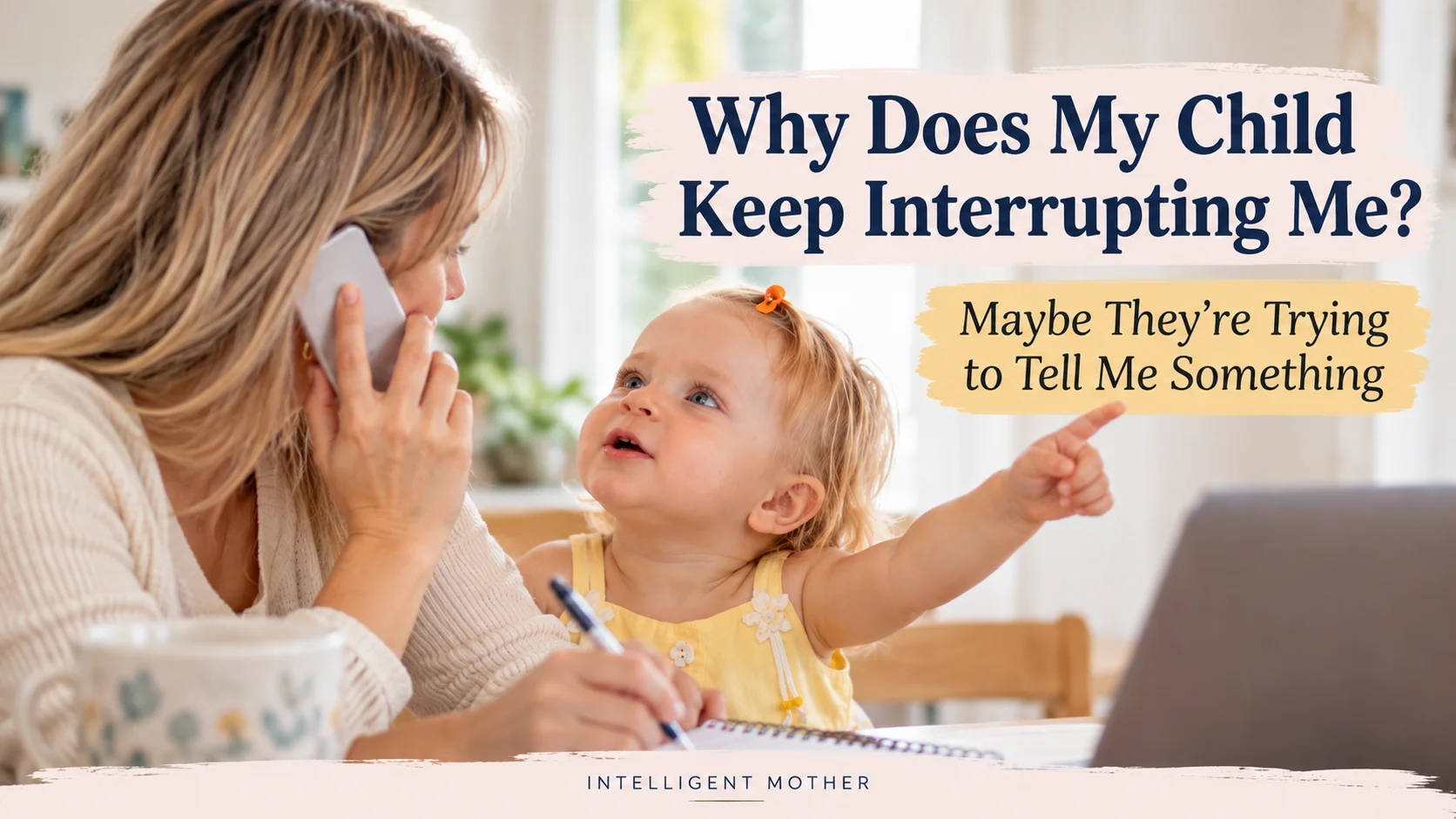
Why Does My Child Keep Interrupting Me? Maybe They’re Trying to Tell Me Something
I was on the phone with my child’s teacher, asking about next week’s field trip. I still had the list of things we needed to prepare in my hand when I heard:
Everything was going quite smoothly. Until:
“Mom.”
I kept talking.
“Mom.”
I held up one finger.
“Just one minute, honey.”
Silence.
About three seconds.
“Mom, guess what?”
And just like that, my phone call about my child’s field trip officially had a new member.
I don’t know if my child has a sixth sense, but I’m pretty sure she knows exactly when I start talking to someone else. Because that is also the exact moment when she suddenly has a story that absolutely cannot wait another second.
She may have had nothing to say all morning. But the second I put the phone to my ear, she suddenly remembers a yellow dog she saw yesterday, a heart-shaped leaf lying in the yard, or a seventeen-part story about how her brother accidentally took the pink cup.
And of course, none of it can wait.
Some days, by the fifth interruption, I start looking at the ceiling and wondering: What would Oprah do in this situation? Honestly, I hope she would walk into the room, look at me, and say, “You get five minutes. You get five minutes. Everybody gets five minutes!”
I used to think:
Can’t you wait a little?
Mom is talking.
Mom already told you to wait.
Does this really need to be said right now?
But then, I decided I would call the teacher back because I had an urgent situation waiting for me to deal with. I tried taking a few deep breaths, in the style of that man who holds the Guinness World Record for sitting in ice water, whom I had just watched on YouTube the night before. Miraculously, I seemed a little calmer and a little smarter. I started trying to look at the whole thing differently.
Maybe my child isn’t actually trying to interrupt me.
Maybe she’s trying to tell me something. Maybe:
“I have something I want to tell you.”
“I’m afraid I’ll forget if I wait.”
“I want to be part of this conversation too.”
“I’m really excited.”
“I need Mom to pay attention to me.”
Or simply: “I still don’t know how to wait.”
That is a small shift in perspective. But sometimes, a small change in the way we look at something can make the whole behavior look different.
Waiting is a skill. And my child is still learning it.
Adults have a pretty useful skill: we can think of something and… not say it right away.
For example, I might be on a phone call and think:
“Oh, I need to remember to buy milk tonight.”
I don’t shout it to the person on the other end of the phone.
I don’t turn to the person sitting next to me and announce:
“Mom needs to buy milk!”
I just keep it in my head.
Kids may not be able to do that yet.
A thought appears, and it seems as if their brain has a button labeled:
PLAY IT NOW.
“Mom! I just saw a dog!”
“Mom is on the phone.”
“But it was blue!”
“Dogs aren’t blue, honey.”
“But I saw it!”
And somehow, a phone call about a field trip has turned into an investigation into a blue dog.
But this is what I have to remind myself: being able to wait for your turn, hold a thought in your head, and notice when someone else is talking are all skills children have to learn.
“Don’t interrupt” only tells a child what they are doing wrong.
It doesn’t teach them what to do instead.
And maybe that is the hardest part of parenting.
But sometimes “Mom!” really means “Are you still there?”
And honestly, there are days when I’m not sure I’ve answered that question enough.
Breakfast. Work. Phone calls. A pile of laundry so tall it looks like it may soon start paying rent.
Maybe you’ve heard this kind of repeated conversation too:
“Mom!”
“Wait a minute, please.”
“Mom!”
“Yes, I’m listening.”
Are you exhausted?
I am too. I’m still typing, still doing laundry, still looking for something I’m pretty sure I was holding ten seconds ago.
Then, at night, I finally sit down.
I call someone.
And:
“Mom!”
For the Nth time.
At that moment, honestly, I don’t think: My child needs connection. I think: Can’t you see that Mom is on the phone?
But then I try to look at it from the other side. Maybe my child isn’t thinking: Today I’m going to ruin Mom’s phone call. Maybe she is simply thinking:
“Mom is sitting down.”
“Mom is here.”
“Maybe she’ll look at me now.”
Of course, not every interruption is an emotional cry for help. Sometimes a child just wants to tell you about a dead caterpillar in the yard.
But sometimes, what we call “rude” is simply a child who is still learning how to wait.
And it hardly seems fair to expect a child to know a skill that took us adults years to learn.
Especially when adults still interrupt each other on Zoom all the time.
Maybe my child is simply learning a skill that adults have practiced thousands of times and no longer remember having to learn.
But understanding my child doesn’t mean letting her do whatever she wants.
I think this is where things can easily get misunderstood.
If we say:
“It’s normal for children to interrupt.”
That does not mean:
“So just let them interrupt.”
No.
My child still needs to learn how to wait. She still needs to learn that when someone else is talking, we let them finish. She needs to know that her voice matters, but other people’s voices matter too.
I don’t want to raise a child who is afraid to speak because she is always worried that she is “bothering” people.
But I also don’t want to raise a child who thinks every conversation has to stop the moment she wants to say something.
There is a space between those two things. And our job is to help our children find that space.
So What Can I Do When My Child Keeps Interrupting?
I’m trying to change a few small things.
I don’t always manage it. I’m a mother, not a walking meditation app. But I’m trying.
1. Acknowledge before correcting
Instead of immediately saying, “Don’t interrupt!”
I can say, “I know you want to tell me something.”
Sometimes, just one sentence like that can change the whole mood.
It tells my child:
Mom sees me.
Then I can say, “Let me finish this sentence, and then it’s your turn.” She hasn’t been ignored.
But she also isn’t being taught that speaking louder means she gets her turn first.
2. Give your child a signal that says, “Mom knows you’re here.”
One simple way is to teach your child to gently touch your hand or arm when she wants to say something.
I can keep talking while placing my hand on hers for a second. I don’t have to say anything. It’s just a small signal: “I know you’re waiting.”
This can be especially helpful for younger children who can’t hold a thought in their heads for very long. And I like this better than constantly saying, “Wait.” Because “wait” can sometimes sound like, “Mom doesn’t want to hear you yet.” While the touch says, “I know. I’ll come back to you.”
3. Don’t just say “Wait.” Tell your child how long to wait.
“Wait a minute.”
How long is a minute?
Thirty seconds?
Five minutes?
Two hours?
Until Mom remembers? 😄
For a child, “wait” without an ending point can be very hard to understand.
Instead of:
“Wait for me.”
I can say:
“I need two more minutes to finish this conversation, and then I’ll listen to you.”
Or:
“Let me finish this sentence, and then it’s your turn.”
A child finds it easier to wait when they know what they are waiting for.
And if I say I’ll come back in two minutes, I need to try to actually come back. Because if Mom always says “one minute” and then disappears for twenty minutes, next time my child may stop believing in Mom’s “one minute.”
4. Don’t just teach your child what not to do. Teach them another way to join the conversation.
“Don’t interrupt.”
Okay.
But if I don’t interrupt, then what do I do?
My child can:
Touch Mom’s hand gently.
Say, “Mom, can I tell you something?”
Wait for a pause.
Or, if she is still very young, use a signal that we have agreed on together. I think this is an important part of teaching children.
Don’t just take away a behavior. Replace it with another skill.
Because a child can’t magically go from:
“I want to say something!”
to:
“I will now wait gracefully and respectfully for my turn in this conversation.”
At least my child can’t.
And honestly, I’m not sure adults always can either.
5. Practice when nobody is angry
This may be my favorite one.
Don’t wait until you are on the phone, dinner is burning, the baby is crying, and your older child is shouting:
“Mom! Mom! Mom!”
and then try to teach your child about waiting.
That is not exactly the ideal moment for a lesson.
Try playing instead.
“Let’s pretend Mom is on the phone.”
You talk.
Your child waits.
Your child touches your hand.
You look at her and say:
“I know you want to tell me something. Wait just a little, okay?”
Then you finish:
“Okay. Now it’s your turn.”
Children learn a lot through play.
And sometimes, a skill practiced while both of you are having fun is much easier to use when real life starts getting messy.
But there are times when your child should be allowed to interrupt
I want to teach my child this too.
Not every interruption is bad.
If she sees fire.
If someone is hurt.
If there is danger.
If she needs help right away.
Interrupt.
I want her to know that sometimes, politely waiting is not the most important thing.
So the goal is not:
“You must never interrupt.”
It is:
“Learn to recognize when you need to wait and when you need to speak right away.”
That is the skill she will carry with her as she grows up.
There are a few things I’m trying not to say anymore
“You’re being rude.”
“Can’t you wait?”
“How many times have I told you?”
“Stop talking.”
I may still let one slip out.
Of course.
I’m human.
Some days, “Don’t interrupt” comes out before I have time to think.
But I’m trying to remember that a sentence like that only tells my child:
“Don’t do that.”
While what she really needs to know is:
“Then what do you want me to do?”
And those are two very different things.
Maybe I don’t want a child who never interrupts
I think about this quite a lot.
If I had a choice, I wouldn’t want to raise a child who never interrupts me.
I want her to know how to wait.
I want her to know how to listen.
I want her to know how to let other people finish their sentences.
I want her to know when something is truly urgent.
I want her to know how to join a conversation without taking it over.
But I also want her to still feel comfortable running to me and saying:
“Mom, I have something to tell you.”
Because one day, she will grow up.
She will have little secrets.
Sad feelings she doesn’t yet know how to name.
Hard questions.
Things that happen at school.
A friend who hurts her feelings.
Something that makes her incredibly happy.
And I hope that, when that day comes, she will still think:
“Mom is someone I can talk to.”
I don’t want teaching her to wait to accidentally become teaching her to stay quiet.
Next time I’m on the phone and I hear:
“Mom!”
Maybe I’ll still sigh.
I may still think:
Please, just let Mom finish this sentence.
I’m not a saint. But maybe I’ll try to remember that behind that “Mom!” is a child who has something she wants to say.
Maybe she is excited. Maybe she is afraid she’ll forget. Maybe she wants my attention. Maybe she is still learning how to wait. Or maybe she just wants to make sure Mom is still there.
And sometimes, before teaching a child how to wait, maybe we need to give them something simpler to understand:
Waiting does not mean you will be forgotten.
Because learning to wait should never mean learning that your voice doesn’t matter.
And tomorrow, there’s a very good chance my little girl will interrupt me again.
She’s still little.
I think I’ll survive.
After all, it seems that phone calls made by mothers with young children are already a group activity. 😄
Questions Parents Often Ask
Is it normal for young children to interrupt when someone else is talking?
Yes. Young children are still developing the ability to control impulses, wait their turn, and understand the rules of conversation. That doesn’t mean parents shouldn’t teach them how to wait and join a conversation appropriately.
How can I teach my child not to interrupt?
Teach a specific replacement behavior, such as gently touching your hand, saying “Mom, can I tell you something?”, or waiting until the other person finishes speaking. Practicing during calm moments is usually much easier than correcting the behavior in the middle of a stressful situation.
Should I ignore my child when they interrupt?
Not necessarily. You can acknowledge that your child wants to say something while still keeping the boundary: “I know you want to tell me something. Let me finish this sentence, and then I’ll listen.” This helps the child feel seen while also practicing the ability to wait.
When should a child be allowed to interrupt?
When there is danger, someone is hurt, or the child needs urgent help. Children need to understand that there are situations where speaking up right away is more important than waiting for their turn.
What if my child keeps interrupting all the time?
Try noticing when it happens, who your child is talking to, and what is happening around them. Your child may be having difficulty with impulse control, turn-taking, social communication, language, or may simply be seeking attention. If the behavior comes with significant difficulties in communication or learning, it is better to talk with a teacher or an appropriate professional rather than trying to decide the cause on your own.