
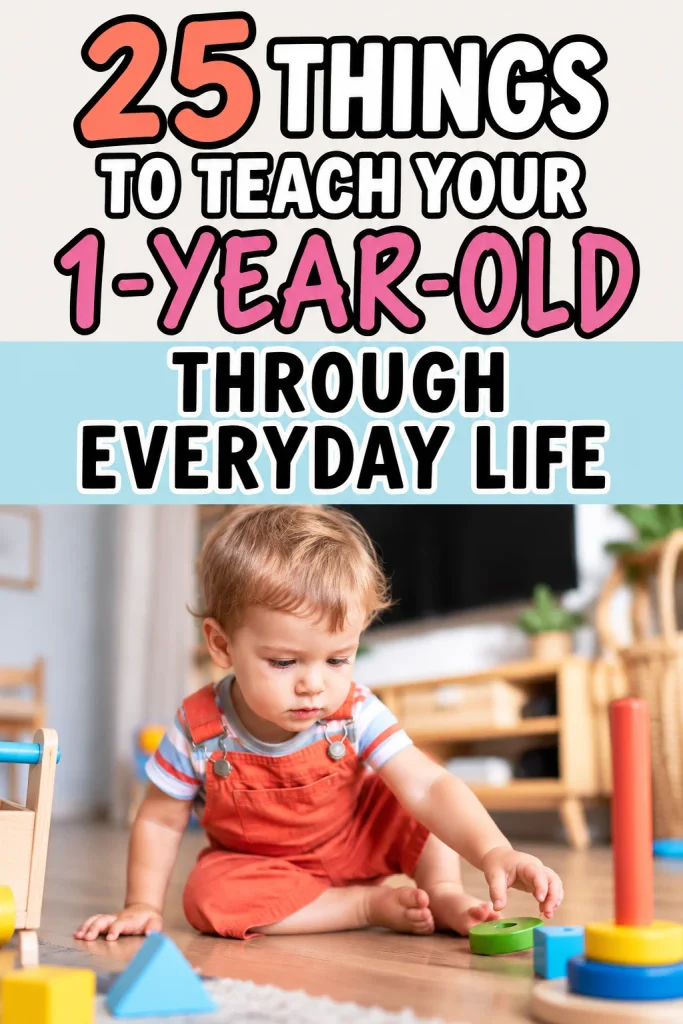
25 Things to Teach Your 1-Year-Old Through Everyday Life
Your Home Is Already a Classroom
When your baby turns one, a funny little question often starts popping into your head:
“Am I teaching my child enough?”
You see toddlers online recognizing colors, counting to ten, or somehow knowing the alphabet before breakfast, and suddenly you wonder if you should be doing more.
Take a breath.
Your 1-year-old does not need a classroom in the living room.
They need a chance to explore the real world.
Your child is learning when they watch you fold a towel.
They are learning when they drop the spoon for the 47th time.
They are learning when they help water a plant, turn the pages of a book, or try to wipe up a tiny spill.
At this age, teaching doesn’t look much like school.
It looks like everyday life.
Here are 25 simple things you can start teaching your 1-year-old through ordinary moments at home.
Before You Start: Teaching Doesn’t Mean Rushing
Every child develops at their own pace.
The ideas below are not a checklist of things your child must be able to do. Think of them as little opportunities to introduce new skills.
If your toddler is interested for 30 seconds and then wanders away to inspect a sock, that’s okay.
Very okay.
The goal isn’t to get through the list.
The goal is to give your child chances to try.
As an Amazon Associate, Intelligent Mother earns from qualifying purchases.
Mom's Everyday Favorites
Thoughtful finds for busy days, family life, and a little time for yourself.
25 Things to Teach Your 1-Year-Old Through Everyday Life
1. Teach Them the Names of Everyday Things
You don’t need flashcards to build your toddler’s vocabulary.
Just talk about the world around you.
Try saying:
- “Here’s your spoon.”
- “The cat is sleeping.”
- “Mommy is washing the dishes.”
Your child hears new words all day long. The more you name the things they see, touch, and use, the more connections they can make between words and the world around them.
Try this: Point to something your child is already looking at and name it.
“Look! A red car.”
Simple. No lesson plan required.
2. Teach Them to Point to Things
Pointing is more than a cute little toddler habit.
It’s a way of communicating before words fully arrive.
When your child points at a cup, don’t always hand it over immediately.
Try saying:
“You want your cup?”
You are helping your child connect a gesture with meaning and showing them that communication goes both ways.
They point.
You respond.
That’s a conversation.
3. Teach Them Body Parts
Bath time, diaper changes, and getting dressed are perfect opportunities.
Point to your nose:
“Where’s Mommy’s nose?”
Then point to your child’s:
“There’s your nose!”
You can do the same with eyes, ears, mouth, hands, feet, and belly.
Don’t worry if your toddler thinks their belly button is the most fascinating body part on Earth.
For now, that’s perfectly acceptable research.
4. Sing the Same Songs Again and Again
You don’t need a beautiful singing voice.
Your toddler is not judging you.
Probably.
Simple songs with repetition are wonderful for young children. Sing during bath time, while getting dressed, or before bed.
You can even make up tiny songs about your routine:
“Time to put our socks on,
one sock, two socks!”
Repetition helps children recognize sounds, patterns, and what comes next.
And yes, you may eventually sing the same song 14 times in a row.
Welcome to toddlerhood.
5. Let Them Turn the Pages
A 1-year-old doesn’t need to sit quietly through an entire story.
In fact, they probably won’t.
Let them:
- turn pages
- point at pictures
- touch the book
- make animal sounds
- stop at a picture they like
You might read three sentences.
Your toddler might read zero.
That’s fine.
Three happy minutes of reading together still count.
6. Teach Them to Put Toys Away
Don’t expect your toddler to clean the playroom.
That’s a job for a tiny army.
Instead, start with one toy. As an Amazon Associate, Intelligent Mother earns from qualifying purchases. Thoughtful picks related to this article.Helpful products to explore

Hand your child a block and say:
“Where does this go?”
Walk over to the basket together and drop it in.
Then try another one.
Soon, putting toys away can become part of the play routine.
And if your toddler puts one block away and runs off?
Congratulations.
You have officially completed toddler housekeeping for the day.
7. Teach Them to Wipe Up Small Spills
When your toddler spills a little water, your first instinct may be to grab a towel and fix it yourself.
Next time, hand them a small cloth.
Say:
“Oops! Water spilled. Let’s wipe it up.”
Will the table actually become cleaner?
Maybe.
Will your toddler smear the water around and somehow make things wetter?
Also maybe.
But they’re practicing coordination, following a simple sequence, and learning that little problems can be solved.
Don’t aim for a spotless table.
Aim for a child who wants to help.
8. Let Them Practice Feeding Themselves
Meals can get messy.
Very messy.
But letting your toddler pick up food, use their fingers, or practice with a spoon gives them valuable opportunities to build coordination and independence.
You don’t have to wait until they can do it perfectly.
At one, messy is part of the process.
Put down the wipe.
Take a breath.
Let them try.
9. Practice Drinking From a Cup
Offer a small amount of water in a toddler-friendly open cup while you’re there to help.
Your child may take a sip.
They may spill half of it.
They may decide the cup itself is much more interesting than the water.
All of that is part of learning.
The goal isn’t a perfectly dry floor.
The goal is practice.
10. Let Them Help Get Dressed
When you’re putting on a shirt, slow down for a moment.
Instead of doing everything for your child, give them a chance to participate.
You might say:
“Where’s your arm?”
Let them try to find the sleeve.
They may put their hand into the wrong hole.
That’s okay.
Give them a little time before jumping in.
A few extra seconds of trying can build a lot of confidence.
11. Teach Them to Push and Pull
Toddlers love things that move.
A sturdy box, toy wagon, or safe push toy can become a simple way to practice movement.
Your child can push it across the room.
Pull it back.
Turn around.
Try again.
They’re working on balance, coordination, strength, and figuring out how their body affects the things around them.
12. Give Them Safe Chances to Climb
Toddlers are natural little explorers.
If you have a safe, low surface or a soft play area, let your child practice climbing while you stay close. As an Amazon Associate, Intelligent Mother earns from qualifying purchases. Thoughtful finds for busy days, family life, and a little time for yourself.Mom's Everyday Favorites


Try not to lift them to the top every time.
Sometimes it’s better to let them figure out where to put their hands and feet.
You are right there if they need help.
13. Let Them Carry Things
Toddlers love having a job.
Even when the “job” is carrying one sock from the bedroom to the laundry basket.
Try:
“Can you bring this to Daddy?”
Or:
“Can you put this in the basket?”
They get to practice walking, carrying, following a simple instruction, and being part of the family.
And suddenly that random toddler who has been carrying your remote control around all morning has a legitimate career.
14. Dance Together
Put on a song and dance.
That’s it.
No special equipment.
No toddler dance class required.
Move your arms.
Clap.
Bounce.
Spin around.
Let your child copy you.
Music and movement give children opportunities to practice rhythm, coordination, balance, and expression. A BEAUTY FIND Moisturizing cream for face and body with ceramides and hyaluronic acid.
CeraVe Moisturizing Cream
And honestly, five minutes of dancing can be good for grown-ups too.
15. Let Them Explore Different Textures
When it’s safe, give your toddler chances to experience different surfaces.
They might walk barefoot on:
- grass
- a soft rug
- sand
- a wooden floor
- dry leaves
Different textures give their senses new information about the world.
Of course, check the area first for anything sharp, hot, dirty, or unsafe.
Your toddler’s feet are curious.
They are not invincible.
16. Play With Water
You don’t need an elaborate sensory table.
A bowl, a few cups, and a little water can be enough.
Let your child pour, scoop, fill, and dump.
They are beginning to notice ideas like:
- full and empty
- more and less
- wet and dry
- pour and spill
And water has a magical ability to keep toddlers busy for longer than you would expect.
Just stay close and supervise.
17. Play “In and Out”
Give your toddler a box or container and a few large, safe objects.
Let them put things in.
Then take them out.
Then put them in again.
And again.
And again.
Yes, this can keep going for an impressive amount of time.
Your toddler is learning about space, object relationships, and cause and effect. As an Amazon Associate, Intelligent Mother earns from qualifying purchases. Thoughtful picks related to this article.Helpful products to explore

Sometimes the simplest games are the ones little brains love most.
18. Let Them Make Some Noise
A wooden spoon and a plastic container can become a toddler drum set in approximately three seconds.
Let your child safely explore different sounds using age-appropriate household objects.
Tap.
Bang.
Shake.
Stop.
Then do it again.
Your toddler is learning that their actions can create different results.
Just maybe don’t introduce this game during your neighbor’s nap time.
19. Take Slow Walks Outside
You don’t always have to go somewhere.
Sometimes, just go outside and slow down.
Stop for:
- an ant
- a bird
- a leaf
- a flower
- a passing truck
- the sound of the wind
Your toddler is learning to notice the world.
And you’re teaching something that is easy to forget in a busy life:
There is no need to rush past everything.
20. Start Simple Pretend Play
Pretend play can begin with very simple actions.
Feed a stuffed animal.
Give a doll a blanket.
Put a toy car “to sleep.”
Pretend to drink from an empty cup.
Your toddler may copy what you do, and that’s the point.
They are beginning to understand that objects, actions, and people can represent something beyond what is happening right now.
And yes, the teddy bear will probably need dinner too.
21. Teach Them to Wave Hello and Goodbye
You don’t need to force your toddler to greet people.
Instead, model it.
Wave when someone arrives.
Wave when someone leaves.
Say:
“Bye-bye!”
Over time, your child may start doing it on their own.
Toddlers learn a huge amount by watching what we do.
Sometimes the best lesson is simply being the example.
22. Practice Taking Turns
Turn-taking can start with very simple games.
Roll a ball back and forth.
Take turns putting blocks into a box.
Pass a toy between you.
Say:
“Mommy’s turn.”
Then:
“Your turn!”
Your child won’t suddenly become a perfect little sharer.
That’s not the goal.
You’re simply introducing the idea that sometimes I go, sometimes you go.
23. Teach Gentle Hands
Toddlers are still figuring out how much force their little hands should use.
If your child grabs the cat too roughly or pats a baby’s head too hard, don’t just say:
“No!”
Show them what to do instead.
Gently guide their hand and say:
“Gentle hands.”
Then demonstrate a soft touch.
Children learn kindness partly through experiencing it.
24. Let Them Help With Little Household Jobs
Your 1-year-old cannot do the laundry.
But they can help you put clothes into the basket.
They can’t clean the kitchen.
But they can carry a napkin to the table.
They can’t water the entire garden.
But they can help pour a little water into a plant with you.
These tiny jobs teach something bigger than the task itself:
“I am part of this family. I can contribute.”
That feeling matters.
25. Teach Them That Trying Matters
This might be the most important lesson of all.
When your toddler is struggling to open a container, put on a shoe, pick up a spoon, or fit a toy into a hole…
Pause before doing it for them.
Give them a few extra seconds.
Let them try.
Maybe they’ll figure it out.
Maybe they won’t.
Either way, they’re practicing persistence.
You can simply say:
“You’re trying. Try again.”
Sometimes your job isn’t to solve the problem.
Sometimes your job is to give your child enough space to discover that they can try.
What Does a “Learning Day” Actually Look Like?
It probably doesn’t look like a classroom.
It might look like this:
| Everyday moment | What your child is learning |
| Folding towels together | Imitation and coordination |
| Picking up a banana | Fine motor skills and independence |
| Watering a plant | Responsibility |
| Playing with water | Early science and cause-and-effect |
| Reading before bed | Language and connection |
| Putting toys in a basket | Following simple routines |
| Dancing in the kitchen | Rhythm and movement |
| Helping with laundry | Participation and practical life skills |
Notice something?
None of these require a fancy toy.
Most don’t require a special activity either.
Your kitchen, laundry basket, garden, bookshelf, and living room are already full of opportunities to learn.
Your 1-Year-Old Doesn’t Need More Lessons
One year old is such a funny age.
Your child is curious about everything.
They want to touch everything.
They want to carry everything.
They want to taste approximately everything that isn’t nailed down.
And they want to do things themselves. As an Amazon Associate, Intelligent Mother earns from qualifying purchases. Thoughtful picks related to this article.Helpful products to explore


So don’t worry about turning every part of the day into a learning activity.
Let them watch you.
Let them copy you.
Let them make a mess.
Let them try.
Let them help.
Let them be curious.
Because for a 1-year-old, ordinary life is extraordinary learning.
As an Amazon Associate, Intelligent Mother earns from qualifying purchases.
Mom's Everyday Favorites
Thoughtful finds for busy days, family life, and a little time for yourself.