
Why Is My Toddler Fighting Bedtime? 9 Common Reasons and What to Do
There’s a moment almost every toddler parent knows.
You gave your child a bath.
Pajamas are on.
Teeth are brushed.
You read a book.
You even gave that extra-special bedtime cuddle.
You turn off the light.
Pull up the blanket.
Kiss your little one on the forehead and whisper:
“Good night, sweetheart.”
You make it about three steps toward the door.
Then you hear:
“Mommy, I’m thirsty!”
So you turn around.
Give them some water.
Another kiss.
Another good night.
You make it to the door.
Then:
“Mommy, I have to go potty!”
Fine.
Potty.
Back to bed.
Blanket.
Kiss.
Good night.
You take two steps.
Silence.
Fourteen seconds later:
“Mooooommy…”

At this point, you may start wondering:
Is my child actually trying not to sleep?
Or worse:
Am I doing something wrong?
Probably not.
You may simply have a toddler.
And bedtime, for a toddler, can sometimes feel like a diplomatic negotiation where the other side has about 40 words in their vocabulary but somehow holds veto power over everything.
As an Amazon Associate, Intelligent Mother earns from qualifying purchases.
Mom's Everyday Favorites
Thoughtful finds for busy days, family life, and a little time for yourself.

You’re Not the Only One
Bedtime resistance is incredibly common during the toddler years.
A 2025 study of 318 mothers with children between 12 and 36 months found that 61.3% of toddlers showed bedtime resistance or delaying behaviors. These behaviors occurred, on average, more than four nights a week.
The children who regularly resisted bedtime also tended to take longer to fall asleep, wake more often during the night, and get less total sleep. A BEAUTY FIND Moisturizing cream for face and body with ceramides and hyaluronic acid.
CeraVe Moisturizing Cream
So if your family is currently going through a phase of:
“Bedtime used to be easy. What happened?”
You are very much not alone.
But there’s something even more important to understand.
Not every bedtime battle has the same cause.
And that’s where we should start.
First, Figure Out What Your Toddler Is Actually Fighting
This is the part I wish more toddler-sleep advice talked about.
When a child refuses to sleep, we usually notice the behavior first.
They won’t lie down.
They keep getting out of bed.
They ask for water.
They cry.
They call for Mom or Dad.
They suddenly have seventeen urgent things to discuss.
But the behavior is only the surface.
Underneath it, there may be a completely different story.
Maybe your toddler isn’t tired yet.
Maybe they’re overtired.
Maybe they want a little more control.
Maybe they need some connection before separating from you.
Maybe they’ve learned that they need you in order to fall asleep.
Or maybe…
they’re scared.
Let’s look at what might actually be going on.
1. They May Not Be Tired Enough
This one is easy to miss.
You look at the clock.
8:00 PM.
“Okay. It’s bedtime.”
But your toddler’s body may not have received the memo.
If your child is still cheerful, chatty, playful, and perfectly happy to rearrange their stuffed animals at 8:30, the problem may not be that they’re “refusing” to sleep.
They may simply not have enough sleep pressure yet.
A nap that is too long or too late can sometimes reduce the need for sleep at night.
That doesn’t mean you should immediately drop the nap.
It means you may need to look at the whole day instead of staring at the clock at 8 PM.
Try this:
For a few days, notice:
- What time does your toddler wake up?
- When do they nap?
- How long is the nap?
- Do they actually look sleepy at bedtime?
- How long does it take them to fall asleep?
Sometimes a small schedule adjustment can take a surprising amount of drama out of bedtime.
2. Or They May Be Too Tired
Here’s the annoying part about toddler sleep:
You might think that the more tired a child gets, the easier they’ll be to put to bed.
If only toddlers worked like phones.
Low battery: 3%. Please shut down.
Unfortunately, the human body doesn’t always cooperate that neatly.
An overtired toddler may become cranky, restless, emotional, or surprisingly energetic.
The child who said at 7:00:
“I’m not tired.”
may become the child sprinting around the bedroom at 8:30 like they’ve just discovered an imaginary energy drink. A BEAUTY FIND A hydrating essence for a moisture-focused skincare routine.
COSRX Advanced Snail 96 Mucin Power Essence
Tresillian notes that overtired toddlers can have difficulty settling and getting to sleep.
Try this:
Instead of waiting until your child looks completely exhausted, start noticing their earlier sleepy cues.
And remember:
The goal isn’t to make your toddler as tired as possible.
The goal is to help them reach bedtime sleepy enough to settle comfortably.

3. Your Toddler Has Discovered One Very Powerful Word: “No.”
If you live with a toddler, you probably know this word well.
No.
No pants.
No teeth.
No bath.
No turning off the TV.
No bedroom.
No lying down.
No sleeping.
Toddlers are developing a much stronger sense of independence.
And bedtime is one of the moments when they may feel that independence slipping away.
All day long, adults make decisions for them.
What to eat.
What to wear. As an Amazon Associate, Intelligent Mother earns from qualifying purchases. Thoughtful picks related to this article.Helpful products to explore


Where to go.
When to leave the playground.
When to take a bath.
And then, at night:
“It’s time for bed.”
Your toddler may be thinking:
Wait a minute. Can I decide anything around here? A BEAUTY FIND Washable mascara for everyday makeup looks.
Maybelline Lash Sensational Sky High Washable Mascara
The development of independence and a desire for control can contribute to bedtime resistance in young children.
This is where small choices can help.
Instead of asking:
“Do you want to go to bed?”
You already know where that conversation is going.
Try:
“Blue pajamas or yellow pajamas?”
“One book or two?”
“Do you want me to sing or read?”
You’re still holding the boundary.
But your child gets a little bit of control inside that boundary.
Sometimes that tiny bit of ownership is enough to make bedtime feel less like something being done to them.
4. Maybe They Don’t Want to Sleep. Maybe They Just Don’t Want You to Leave.
This is one of the easiest things to misunderstand.
A toddler may say:
“I don’t want to sleep!”
But what they really mean may be closer to:
“I don’t want you to leave.”
Bedtime is a tiny separation.
The day ends.
The lights go out.
Mom or Dad walks away.
And for a developing child, especially one experiencing separation anxiety or nighttime fears, that can feel surprisingly big. A BEAUTY FIND Daily facial moisturizer with ceramide-3 and niacinamide.
La Roche-Posay Toleriane Double Repair Face Moisturizer
That’s why a child can be perfectly happy all day…
and suddenly become:
“Stay with me.”
“Don’t go.”
“Lie down with me.”
Try one simple thing:
Connect before you separate.
Spend a few quiet minutes together.
Have a cuddle.
Read a short story.
Ask:
“What was your favorite part of today?”
Not to turn bedtime into a 45-minute emotional summit.
Just enough to help your child feel:
“Mom is still here. We’re connected. And now it’s time to sleep.”
5. They May Have Learned a Specific Way to Fall Asleep
Think about how your toddler usually falls asleep.
Maybe you lie beside them.
Maybe you rub their back.
Maybe you rock them.
Maybe you sing.
Maybe you nurse.
Maybe there’s one very specific sequence that has become part of bedtime.
Over time, your child’s brain can learn:
“This is how I fall asleep.”
That’s called a sleep association.
And sleep associations are not automatically bad.
A lot of the things parents do to help children sleep are completely normal.
The problem comes when a child becomes dependent on a particular condition in order to fall asleep or get back to sleep. A BEAUTY FIND Moisturizing cream for face and body with ceramides and hyaluronic acid.CeraVe Moisturizing Cream
If you want to change it, you don’t necessarily have to remove everything overnight.
You can gradually reduce the amount of help.
For example:
Mom lies beside the bed As an Amazon Associate, Intelligent Mother earns from qualifying purchases. Thoughtful finds for busy days, family life, and a little time for yourself.
↓
Mom sits beside the bed
↓
Mom moves a little farther away
↓
Mom sits near the door
↓
Mom says good night and leavesMom's Everyday Favorites


Not every child needs this exact progression.
The point is simply:
You’re teaching a new skill, not taking away a sense of safety.
6. “One More Thing!” May Actually Be a Bedtime Strategy
This one is almost universal.
“I’m thirsty.”
You give water.
“I have to go potty.”
You take them.
“One more book.”
You read.
“I need a hug.”
You hug.
“I forgot to tell you something.”
You listen.
And suddenly you realize…
Your toddler is running a 24-hour hotel.
These kinds of delaying behaviors are often described as limit-setting problems, where children resist bedtime by making additional requests or finding reasons to stay awake. A BEAUTY FIND A niacinamide serum for a simple everyday skincare routine.
The Ordinary Niacinamide 10% + Zinc 1%
The trick is to set the boundary before the negotiations begin.
If you’re reading two books, say:
“Tonight we’re reading two books, and then it’s lights out.”
When your toddler asks:
“One more book!”
You don’t need to launch into a 20-minute bedtime debate.
You can simply say:
“I know you want another one. We already read our two books. It’s sleep time.”
Calm. Boring. Consistent.
That’s it.
Bedtime does not need to become a courtroom where the winner receives an additional story.
7. They May Actually Be Scared
Toddlers have something very powerful developing inside their little heads:
imagination.
A bedroom that looks perfectly ordinary during the day can feel very different when the lights go out.
That chair in the corner?
During the day, it’s a chair.
At night?
Suspicious.
That coat hanging on the door?
Definitely up to something.
Nighttime fears have been identified as one factor that can contribute to bedtime resistance in young children.
If your child says, “I’m scared,” start by listening. A BEAUTY FIND A hydrating essence for a moisture-focused skincare routine.COSRX Advanced Snail 96 Mucin Power Essence
You don’t necessarily need to say:
“There’s nothing to be scared of.”
Because to your child, the fear feels very real.
You might say:
“I know you’re scared. I’m here.”
Then help make the room feel safe.
Maybe that means:
- a soft night-light
- a familiar comfort object
- checking the room together
- keeping the bedtime routine predictable
The goal isn’t to prove that your child’s fear is silly.
The goal is to help them learn:
“I can feel scared and still be safe.”
8. Your Bedtime Routine May Be Too Long
Here’s another funny little parenting trap.
You want to create a really good bedtime routine.
So the routine grows.
Bath.
Pajamas.
Teeth.
Story.
Second story.
Song.
Massage.
Water.
Another song.
Special cuddle.
Another cuddle.
A serious discussion about dinosaurs.
And suddenly…
11:14 PM.
A good bedtime routine doesn’t have to be long.
It needs to be predictable. A BEAUTY FIND Washable mascara for everyday makeup looks. As an Amazon Associate, Intelligent Mother earns from qualifying purchases. Thoughtful picks related to this article.Maybelline Lash Sensational Sky High Washable Mascara
Helpful products to explore

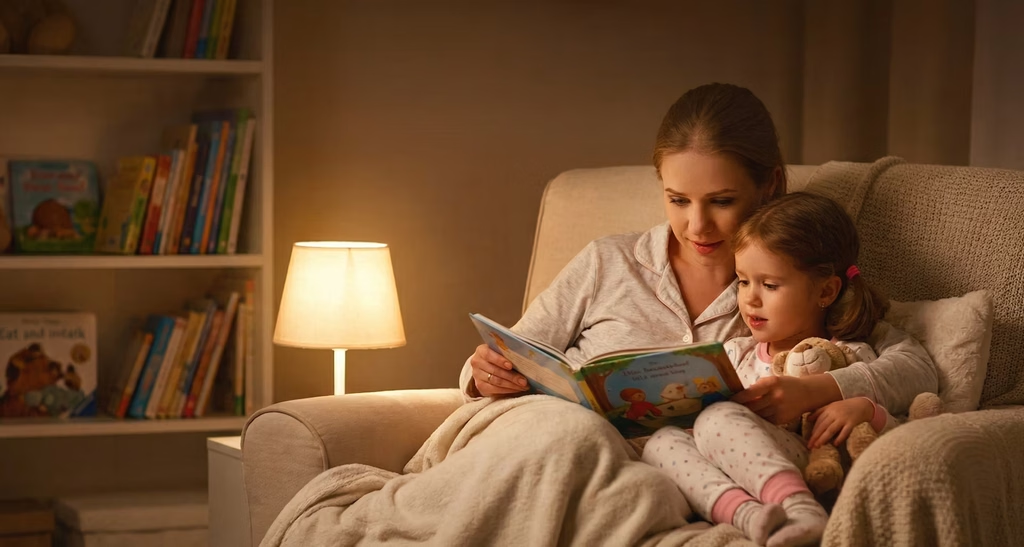
Guidance on toddler sleep commonly recommends a familiar sequence of quiet activities that happens in roughly the same order each night. This gives children cues that bedtime is approaching and helps them settle.
Something as simple as:
Bath → pajamas → teeth → book → cuddle → bed
can be enough.
Your toddler does not need a five-star sleep retreat.
9. Look at the Whole 24 Hours
This may be the most important piece to remember.
Parents often ask:
“How do I get my toddler to sleep at 8 PM?”
But a better question may be:
“What did my toddler’s sleep look like over the entire day?”
The American Academy of Sleep Medicine recommends approximately:
- 11–14 hours of sleep per 24 hours for children ages 1–2, including naps.
- 10–13 hours for children ages 3–5, also including naps.
A BEAUTY FIND
La Roche-Posay Toleriane Double Repair Face Moisturizer
Daily facial moisturizer with ceramide-3 and niacinamide.
View on AmazonA nap that happens too late may make bedtime harder.
A bedtime that happens too late may leave a child overtired.
Too much daytime sleep may mean your toddler simply isn’t ready for another long stretch of sleep yet.
Toddler sleep is a little like a pizza.
You can’t stare at one slice and decide the whole pizza is broken.
So, What Can You Actually Do Tonight?
You don’t need to overhaul your family’s entire life tonight.
Seriously.
Try these five small things first.
1. Start winding down before bedtime
Gradually move away from stimulating activities.
Dim the lights.
Choose quieter activities.
Slow your voice down.
Let the whole house begin sending the same message:
“The day is winding down.”
2. Keep the bedtime routine short and predictable
It doesn’t have to be perfect.
It just needs to feel familiar.
Same general order. Same general feeling.
3. Give your toddler two small choices
Not:
“Do you want to go to bed?”
Try:
“Blue pajamas or green?”
“One book or two?”
You decide when bedtime happens.
Your child gets to decide a few small things within bedtime.
4. Set the boundary before the requests begin
If you’re reading two books: A BEAUTY FIND Moisturizing cream for face and body with ceramides and hyaluronic acid.CeraVe Moisturizing Cream
“Two books tonight.”
If your child needs water, give them water.
But don’t let one glass of water turn into:
water → story → potty → hug → second story → another hug → an existential discussion about why the moon follows the car.
You need sleep too.
5. Don’t try to fix everything at once
If your toddler is:
- taking a long nap
- going to bed late
- needing you beside them
- waking at 5:30 AM
you don’t have to change all four things tonight.
Pick the one or two changes that seem most important.
Try them.
Watch what happens.
Adjust.
Then keep going.
Improving toddler sleep is often less like pressing a giant “FIX SLEEP” button and more like gently turning the wheel of a boat.
Small adjustments can change the direction.
A Small Shift in Perspective
Maybe the most useful question isn’t:
“How do I make my toddler sleep?”
Maybe it’s:
“What is my toddler trying to tell me through this bedtime behavior?”
Maybe they’re saying:
“I’m not tired.”
“I’m too tired.”
“I want to decide something myself.”
“I don’t want the day to end.” A BEAUTY FIND A niacinamide serum for a simple everyday skincare routine.The Ordinary Niacinamide 10% + Zinc 1%
“I’m scared.”
“I need you.”
“I haven’t learned how to fall asleep without you yet.”
The same behavior can come from completely different needs.
And once you understand the need underneath it…
you may stop fighting bedtime and start solving the problem.
One More Thing to Remember
A toddler who fights bedtime isn’t necessarily a toddler who is fighting you.
Sometimes they’re simply wrestling with something that feels enormous inside a very small body:
ending the day, leaving the person they love, and stepping into the darkness of sleep.
You don’t have to make every night perfect.
You just have to help them through it, one small step at a time.
Because one day, you may walk out of that bedroom…
and there will be no:
“Mommy!”
No “one more story.”
No third glass of water. A BEAUTY FIND A hydrating essence for a moisture-focused skincare routine.COSRX Advanced Snail 96 Mucin Power Essence
No emergency dinosaur discussion.
Just a quiet room.
And you may realize that the little child who once needed you beside them to fall asleep has been growing toward independence all along.
So if bedtime becomes another little battle tonight…
Take a breath.
Slow things down.
Give your child an extra cuddle if they need one.
Then try to see bedtime through their eyes.
You’re not just helping your child fall asleep.
You’re teaching them that the world is still safe when the day comes to an end. 🌙
When to Talk With Your Child’s Doctor
Most bedtime struggles are behavioral or developmental, but some sleep problems deserve a closer look.
Talk with your child’s healthcare provider if you notice things such as:
- frequent loud snoring
- difficulty breathing during sleep
- pauses in breathing
- significant daytime sleepiness
- persistent sleep problems that are affecting your child or your family
- concerns that your child is consistently getting far too little or far too much sleep
A BEAUTY FIND
Maybelline Lash Sensational Sky High Washable Mascara
Washable mascara for everyday makeup looks.
View on AmazonIf you’re worried about your child’s sleep, it’s always reasonable to bring those concerns to their pediatrician. The American Academy of Sleep Medicine recommends discussing concerns about unusually low or high sleep duration with a healthcare provider. As an Amazon Associate, Intelligent Mother earns from qualifying purchases. Thoughtful picks related to this article.Helpful products to explore

This article is for general educational purposes and is not a substitute for medical advice from your child’s healthcare provider.
As an Amazon Associate, Intelligent Mother earns from qualifying purchases.
Mom's Everyday Favorites
Thoughtful finds for busy days, family life, and a little time for yourself.