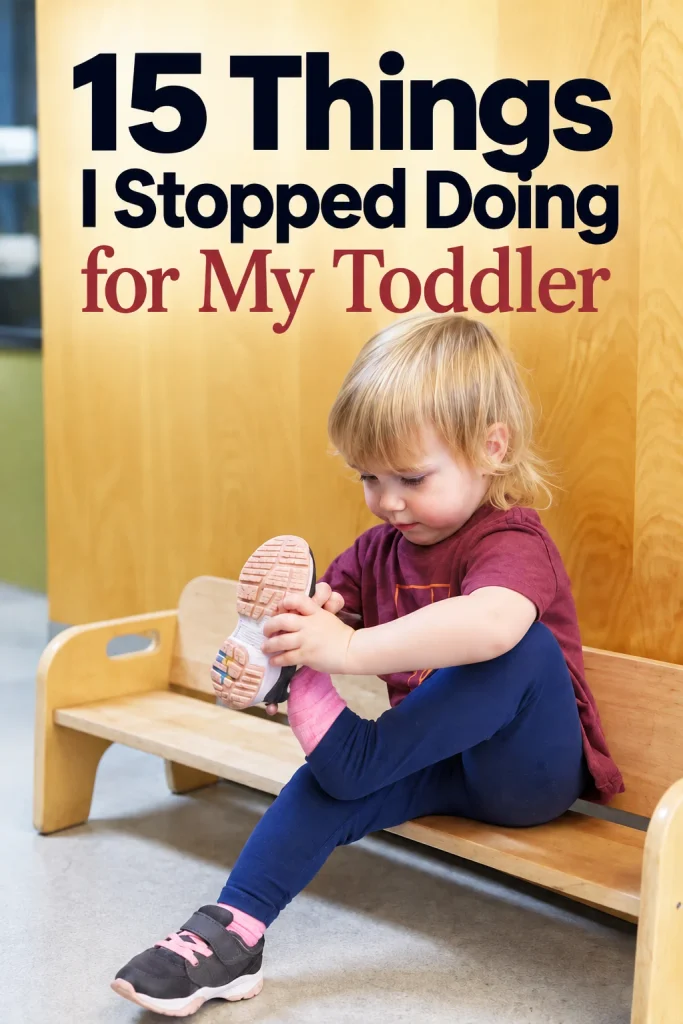
15 Things I Stopped Doing for My Toddler
As an Amazon Associate, Intelligent Mother earns from qualifying purchases.
Mom's Everyday Favorites
Thoughtful finds for busy days, family life, and a little time for yourself.
A confession first
I have to confess something.
For eight straight months, I fetched my daughter’s socks for her, even though she knew exactly where they were.
It wasn’t that she didn’t know where the drawer was. She knew better than I gave her credit for.
One morning, my hands were full with a cereal box when she called:
“Mommy, help me.”
And the easiest thing in the world was to put the cereal down, grab the socks, and hand them to her.
Eight seconds.
Nobody got hurt.
We were both happy. The problem was, she asked again the next day. And I went again. And the day after that. Without meaning to, I had taught a very smart little person that:
Saying “Mommy, help me” worked better than opening the drawer herself.
This isn’t a story about my daughter being lazy.
It’s a story about how parents, even the ones who “know better,” can quietly become unpaid personal assistants to someone who is barely three feet tall.
I’m not writing this to give you a 15-step plan for “building independence,” as if independence were an app you could install by following the instructions in the right order.
I don’t believe that.
And if someone tells you otherwise with absolute confidence, I’d be a little suspicious, even if that someone were me.
These are simply 15 small moments when I realized I could step back.
Not because I’m an especially disciplined mother.
Because I was tired.
And it turns out, sometimes stepping back is easier than jumping in.
1. Let your toddler get their own shoes and things before heading out
Instead of:
“Give me your shoes. I’ll get them.”
try:
“You get your shoes. I’ll get my jacket.”
It won’t look like a laundry detergent commercial.
Some days, your child will put on one shoe and one sandal, then stand in the middle of the room completely forgetting what they were doing, staring at you as if you just handed them a calculus problem.
That’s okay.
Simple things like getting their shoes, grabbing their backpack, or choosing a snack for the car aren’t really about getting it right.
They’re opportunities to practice.
I don’t need to turn getting shoes into a lesson about independence.
I just need to stop getting the shoes when my child is perfectly capable of getting them.
2. Let them carry their own things
You’ve seen this scene before.
Mom is carrying the bag.
The water bottle.
The jacket.
The toy.
The backpack.
Meanwhile, the child walks beside her empty-handed, looking completely relaxed, like they’re on vacation.
I’m not suggesting you hand a toddler a suitcase.
I’m saying that if the little backpack contains one shirt and a light water bottle, they can carry it.
Not because they need to “help Mom.”
But because they can begin to understand:
This is mine.
I’m responsible for it.
There’s a small difference between:
“Can you carry this for Mommy?”
and:
“This is your bag. You carry it.”
I like the second one better.
3. Let them choose between two outfits
Don’t open the entire closet and ask:
“What do you want to wear?”
That question can turn five minutes into a forty-minute cabinet meeting with a toddler.
Instead:
“Red shirt or blue shirt?”
Two choices.
Enough for your child to feel some control.
Not enough to make everyone late.
And if they choose a red shirt with bright green pants that make your eyes need a little vacation?
Fine.
Not every decision needs to be optimized.
4. Let them feed themselves
Of course I can feed my child.
I can do it faster.
Cleaner.
With considerably less food ending up on the floor.
I could probably turn the entire meal into a highly efficient oatmeal production line.
There’s just one small problem:
it’s my child’s meal, not a competition to see how quickly Mom can finish it.
If your child can hold a spoon, let them use it.
Even when the final destination of the oatmeal is the floor instead of their mouth.
It turns out independence often looks pretty messy.
And sometimes the price of letting a child practice is wiping up a little more mess.
I think I can afford that price.
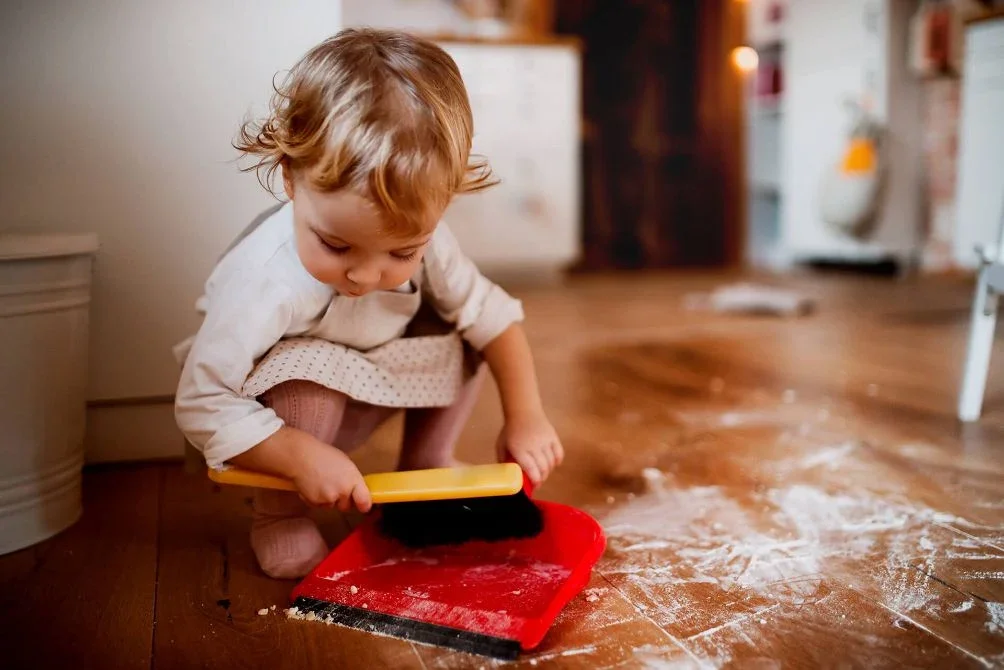
5. Let them clean up their small part of the mess
You don’t need:
“You have to clean your whole room right now!”
Just:
“Can you put these three cars in the bin?”
If your child manages three toys out of forty-seven today, that’s still better than me quietly cleaning up all forty-seven while wondering:
Am I raising a child or an extremely adorable tornado?
I also don’t need to stand over them directing traffic.
“That one goes there.”
“No, that one.”
“What are you doing?”
Maybe they’ll do it completely differently from the way I would.
As long as the cars eventually make it back into their box, I think we can both live with that.
6. Let them carry their dirty clothes to the hamper
I don’t actually believe laundry is some magical Montessori activity.
I just believe kids like knowing what happens next.
Dirty clothes?
Into the hamper.
That’s it.
There’s no need for a speech about responsibility.
No need to clap.
No need to say:
“See? You’re becoming such a responsible person!”
Just do it every day.
A small job repeated often enough eventually becomes part of ordinary life.
7. Let them pour their own water, safely
A small pitcher.
A plastic cup.
A spot they can reach.
Water will spill.
Of course it will.
That’s what towels are for.
Not as punishment.
Just as the appropriate tool for a problem that was always going to happen.
And I’ve realized something slightly ridiculous:
Sometimes I’m more worried about my child spilling water than I am about my child needing to learn how to pour water.
If I always protect the clean floor by keeping the cup in my own hands, the floor stays clean.
But my child gets fewer chances to practice.
Sometimes we protect the cleanliness of our house by giving up a small opportunity for our child to grow.
I don’t want to do that every time.
8. Let them get a simple snack
Your toddler doesn’t need to open a restaurant.
Just:
“Go get the banana from the basket.”
That’s enough.
The goal isn’t for them to prepare a complete meal.
The goal is for them to begin feeling:
“I can take care of one small part of myself.”
And if today they get the banana…
Tomorrow they get a cracker…
And the next day they stand in front of the refrigerator and ask:
“What can I eat?”
Well…
Maybe you’ve created a new problem.
They’re getting very good at choosing for themselves.
9. Let them help set the table
A napkin.
A spoon.
A plastic cup.
No speech about “responsibility” required.
Just:
“Can you bring me two napkins?”
What I love about little jobs like this is that they don’t feel like lessons.
There’s no:
“Today we’re going to learn an important life skill.”
There’s just life happening.
Your child carries the napkins.
You put down the bowls.
You get dinner ready together.
It turns out real life teaches children much better than many lessons designed specifically to teach them.
10. Let them water the plants
A small watering can.
A few plants.
One sentence:
“These plants are your job.”
Kids don’t necessarily need another “activity.”
Sometimes they just need something that genuinely needs them.
The plant needs water.
Your child knows the plant needs water.
Your child waters it.
That’s enough.
There’s no need to turn it into a science project.
No sticker chart.
No reward for every successful watering.
A small living thing depending, in part, on your child is already a pretty real experience.
11. Let them wash their toys
A tub of water.
A little soap.
A few plastic cars.
Technically, this is play.
But practically, your child is practicing a sequence with a purpose:
get it → wash it → rinse it → dry it → put it away.
Nobody needs to call that “executive functioning.”
Your toddler certainly doesn’t need to know what that phrase means. As an Amazon Associate, Intelligent Mother earns from qualifying purchases. Thoughtful finds for busy days, family life, and a little time for yourself.Mom's Everyday Favorites


They just know:
“The car is dirty.”
“The car needs washing.”
And then:
“The car is clean.”
That’s one of the things I love about ordinary jobs.
They have a beginning.
There’s a problem.
There’s a process.
And eventually there’s a result your child can actually see.
12. Let them put their books away after reading
Skip:
“Clean up right now!”
Try:
“This book needs to go home.”
One book.
Then two.
Slowly, things begin to have a place where they belong.
And your child becomes the person who puts them there.
Not you.
I like “take the book home” more than “put the book away.”
Maybe because children understand a little story more easily than a command.
The book has a place to return to.
Your child can take it there.
Done.
13. Let them solve a small problem before calling you
This is the hardest one for me.
“Mom! I can’t find my car!”
My first instinct is to get up immediately.
Find the car.
Look under the chair.
Look behind the sofa.
Sometimes I can find it faster than my child ever could.
But now I try:
“Think about where you were playing with it last.”
Sometimes the answer ten seconds later is:
“MOMMMMM!”
Very loudly.
But sometimes my child comes back holding the car.
And there’s a look on their face I never taught them how to make:
“I just figured that out myself.”
That’s the moment when I have to learn not to step in too quickly.
Not because I want my child to figure everything out alone.
But because I’m starting to realize:
Sometimes my child doesn’t need me to solve the problem. They just need me not to take away the chance to solve it themselves.
Those are two very different things.
14. Let them play by themselves for a while
This might be the thing modern parents need to hear most.
And it’s also one of the hardest things for me.
We’ve become so used to thinking that every quiet minute is a missed teaching opportunity.
Child sitting quietly?
Teach colors.
Child bored?
Find an activity.
Child playing?
Join in.
Child asks a question?
Answer it.
Child gets quiet?
Check what’s happening.
But sometimes…
nothing is happening.
Your child is simply there.
You can sit and drink your coffee.
They can sit on the floor.
You don’t need to invent the next game.
You don’t need to turn every minute of the day into a developmental opportunity.
Maybe at first your child will say:
“Mommy, I’m bored.”
And you’ll have to fight the reflex to jump up and find something for them to do.
Because:
“I’m here, but I don’t need to be part of everything you’re doing.”
isn’t neglect.
It’s space.
And sometimes something wonderful happens inside that space.
Your child figures something out.
Gets a few cars.
Lines them up.
Finds a towel and turns it into a tunnel.
Builds a “garage.”
And suddenly, a little world appears that you never had to design.
Maybe I’ve underestimated children’s creativity because I’ve been too busy trying to create it for them.
15. Let them do one thing you’ve always done for them
This is the real assignment.
Not picking one item from the fourteen above.
Tomorrow, don’t change your child. Watch yourself.
For one day, notice the things you automatically do for your child.
The shoes.
The water.
The jacket.
The toy they dropped.
The missing sock.
The snack.
The zipper.
The toy they can’t find.
You’re doing these things not necessarily because your child can’t.
But because you’ve become the fastest way to solve every little problem.
And maybe that’s what I didn’t understand during those eight months of fetching socks.
My daughter didn’t necessarily say:
“Mommy, help me”
because she couldn’t get the socks.
She said it because she knew:
Mommy would get them.
I had become the fastest solution.
So next time, I’m going to wait.
Maybe five seconds.
Maybe ten.
Maybe I’ll ask:
“Do you want me to help, or do you want to try first?”
And maybe that tiny pause is where things actually begin to change.
“Stepping back” doesn’t mean “walking away”
I want to be clear about this, because it’s easy to take the idea too far.
Letting your child do more doesn’t mean leaving them to figure everything out alone.
A child can be encouraged to do many things independently and still need an adult nearby to keep them safe, especially around:
- water;
- stoves;
- knives;
- stairs;
- traffic;
- small objects that could be choking hazards;
- and anything a young child isn’t developmentally ready to judge for risk.
What we’re reducing isn’t supervision.
It’s unnecessary rescuing.
From a distance, those two things can look pretty similar.
They’re not.
I’m still here.
I’m still watching.
I’m still helping when my child genuinely needs me.
I’m just trying not to become the person who solves everything before my child even gets a chance to try.
What I wish I’d understood sooner
There’s a version of parenting that’s very easy to fall into because it comes entirely from love:
Child needs something → Mom handles it.
Thirsty?
Mom gets the water.
Can’t find the shoe?
Mom finds it.
Drops something?
Mom picks it up.
Bored?
Mom thinks of a game.
Doesn’t know how?
Mom just does it because it’s faster.
None of us do this because we’re lazy or don’t care.
Actually, it’s the opposite.
We do it because we care so much.
We want the morning to move faster.
We want the house to be less messy.
We want our child to stop crying.
We want the meal to end.
We want to get out the door on time.
We want things to be easier.
And sometimes the fastest way to make life easier is…
to do the thing ourselves.
But if that goes on long enough, our child may learn a lesson nobody meant to teach:
“Someone will always do this for me.”
What I actually want my daughter to learn is:
If you don’t know how, I’ll show you.
If you can’t do it yet, I’ll help.
But if you can try, I’ll let you try.
Even when it’s slower.
Messier.
And much less efficient than if I had simply done it myself in eight seconds.
On paper, that’s a very small difference.
But it changes my entire job.
From being the person who does everything for my child
to being the person who steps back far enough to let her do more for herself.
One small change for tomorrow
I’m not going to tell you to try all 15 of these tomorrow morning.
If someone tells you to do that, that’s exactly the kind of “optimize your life” advice I don’t trust.
The kind that makes you feel like you need to become a better version of yourself before the sun is even up.
You don’t.
Just pick one thing.
The next time your child says:
“Mommy, help me.”
try pausing for a second.
Don’t immediately reach for the thing.
Don’t immediately stand up.
Just ask:
“Do you want me to help, or do you want to try first?”
Maybe they’ll still say:
“Help.”
That’s okay.
You still help.
The only difference is that this time, your child was asked before being automatically served.
Maybe they’ll try.
The water will spill.
The shirt will go on backward.
The toys will end up in the wrong bin.
A sock will somehow disappear from the face of the earth, as toddler socks tend to do.
But somewhere between the sock in the wrong drawer and the puddle on the kitchen floor, your child is building something no store sells:
The belief that they can actually do things for themselves.
And maybe that’s what I really want to give my daughter.
Not a childhood where everything is done for her.
And not a childhood where she has to figure everything out alone.
But a childhood where she knows:
If you need me, I’m here.
If you don’t know how, I’ll show you.
If you can’t do it yet, I’ll help.
But if you can try… I’ll let you try.
Maybe raising an independent child doesn’t begin with teaching them to do more.
Sometimes it begins with Mom doing a little less.
Stepping back just far enough.
Waiting a little longer.
And giving your child the chance to discover, one small thing at a time, that:
They are capable of much more than either of you ever gave them credit for.
As an Amazon Associate, Intelligent Mother earns from qualifying purchases.
Mom's Everyday Favorites
Thoughtful finds for busy days, family life, and a little time for yourself.