15 Little Habits That Can Shape the Person Your Toddler Is Becoming
They may look small today. But years from now, they may become part of the way your child lives, loves, and treats the world around them.
“Mommy, I do it myself!”
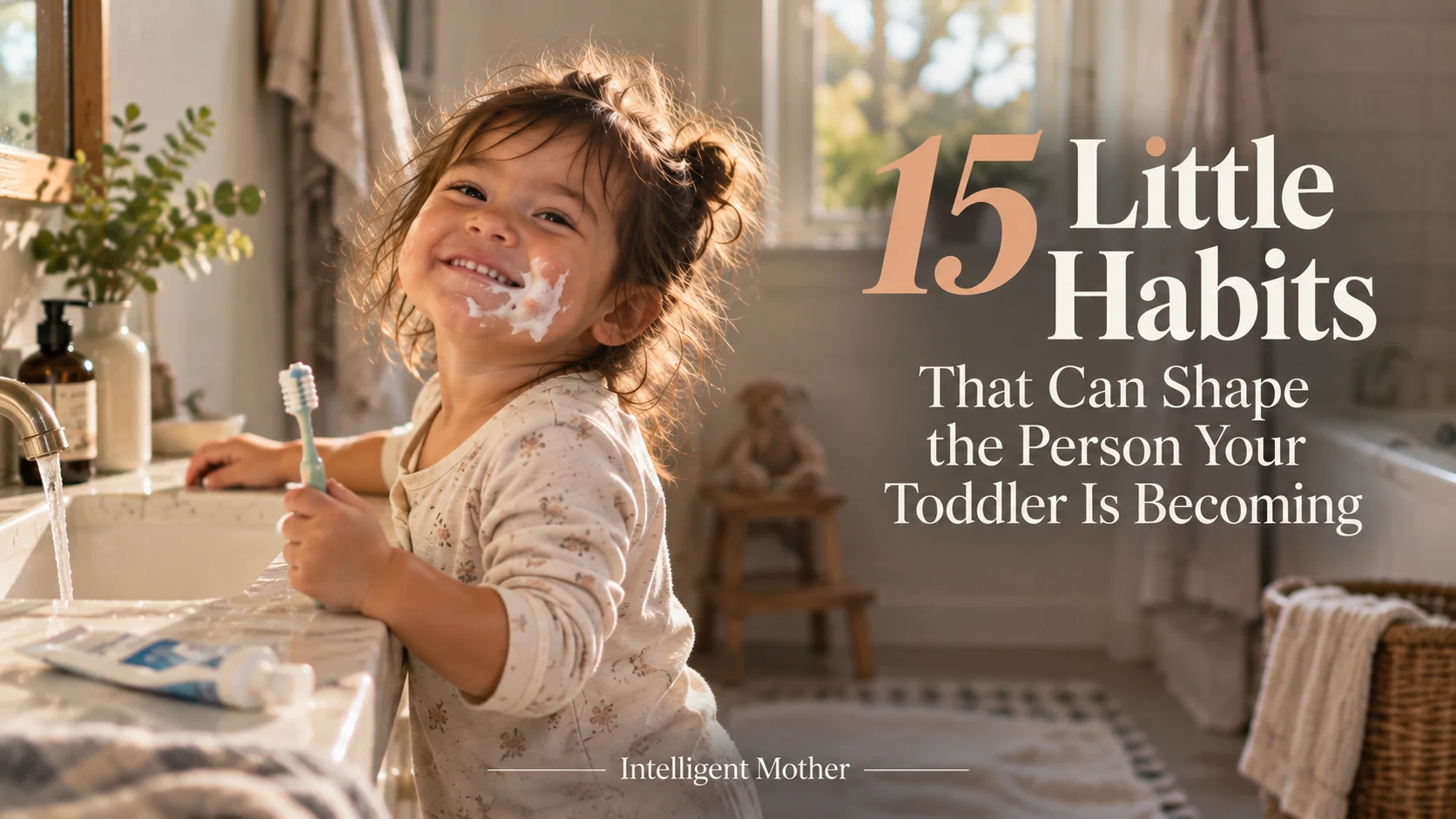
You turn around and find your toddler standing in the middle of the bathroom, toothpaste smeared across one cheek. The toothbrush is upside down in their hand. Water is splashed across the sink. A towel is lying on the floor, and somehow their pajamas have ended up in the bathtub.
You could fix all of it in less than a minute. Take the toothbrush. Wipe their face. Pick up the towel. Rescue the pajamas. Done.
But your child is looking at you with a very clear message:
Don’t. I can do it.
This is one of the first strange paradoxes of parenting. We spend years trying to help our children become independent, yet in the early years, independence often arrives in the most inconvenient form possible. It slows down the morning, makes the bathroom messy, turns a two-minute task into ten minutes, and sometimes requires you to watch a toddler put a sock on the wrong foot when you could have done it correctly in three seconds.
But if you look a little closer, something else is happening.
This isn’t just a child trying to brush their teeth.
This is a child testing themselves against the world.
And perhaps that’s where we should begin when we talk about “good habits” for toddlers.
Not with the question:
How do I make my child better behaved?
But with a more interesting question:
What kind of person is this child slowly becoming?
Because putting a toy away, waiting for a turn, saying thank you, asking for help, or telling the truth after breaking a cup may seem far too small to call “character.”
But big qualities rarely arrive through big lessons.
They are practiced in ordinary moments, repeated so many times that we hardly notice we are teaching them.
Before You Teach a Habit, Look at What Is Growing Beneath It
A child who puts a toy car back in the basket isn’t simply helping keep the living room tidy. They are beginning to experience that the things they use are also things they can care for.
A child who says, “Can you help me?” isn’t simply reaching for another pair of hands. They are learning that struggling with something doesn’t mean they have failed.
A child who waits for their turn isn’t simply standing still for a few more seconds. They are beginning to understand that other people have wants, needs, and turns too.
And a child who tells the truth after breaking a cup isn’t simply answering a parent’s question. They are having one of their first experiences with facing a mistake instead of hiding it.
That’s why I don’t want to think of the 15 things below as a list of things a toddler should already know how to do.
The habit is only what we can see.
What matters more is what is growing underneath it.
Routines give young children structure and help them know what to expect. Small responsibilities give them opportunities to practice independence and contribution. And responsive back-and-forth interactions with caring adults help build the foundations for social, emotional, and language development.
So the goal isn’t to have a toddler who can perfectly perform 15 good habits.
The goal is to give them enough chances to practice them.
1. Put Things Back Where They Belong
There’s a toy car in the middle of the living room.
You step over it once.
Then again.
By the third time, you bend down, pick it up, and think, Why am I always the one doing this?
It’s a very real parenting thought.
But the next time, instead of picking it up and moving on, sit down beside your child.
“Where does the car go?”
If they don’t know, show them.
“In this basket.”
Then let them put it there.
You don’t need to give a speech about responsibility. You don’t need to explain that good children keep the house clean. You don’t even need to make putting away one toy into a grand moral lesson.
Young children learn through repeated experiences in everyday life. Simple, predictable routines and age-appropriate responsibilities give them opportunities to practice what they are capable of doing.
One day, your child will put the toy away without being asked.
But the real lesson won’t be about a cleaner living room.
Your child will be beginning to understand something much bigger:
The things I use are also things I can take care of.
2. Know How to Ask for Help
Your child is trying to zip up their jacket.
It isn’t working.
They try again.
Still nothing.
Finally, the jacket lands on the floor.
There’s a very natural parental reaction in moments like this: just do it for them. You can. And it will be much faster.
But if we solve every difficulty the moment it appears, our child loses something more valuable than the ability to zip a jacket.
They lose the chance to try.
You might say, “Try first.”
Then wait.
If they still can’t do it, ask, “Do you want me to help?”
Toddlers are beginning to seek more independence, and giving them reasonable opportunities to try age-appropriate tasks helps them build that independence over time.
There is a big difference between:
“You have to do it yourself.”
and:
“Try first. I’m here if you need me.”
The second doesn’t make a child weaker.
It teaches something much more useful:
Being independent doesn’t mean you have to do everything alone.
3. Let Familiar Things Become an Anchor
Your toddler is happily playing when you say:
“Bath time.”
And you already know what’s coming.
“No!”
You try again.
“It’s time for your bath.”
“No!”
Suddenly, a ten-minute routine has become a full-scale negotiation.
It’s easy to see these moments as a battle of wills. But transitions can genuinely be difficult for toddlers. Consistent routines help children know what comes next and create a sense of structure and predictability in their day.
You don’t need to turn your home into a military academy.
Just let a few things happen in a familiar order.
Brush teeth. Read a book. Go to bed.
Again and again.
What adults call a “routine” can mean something very different to a toddler:
I know what happens next.
And a world that feels a little more predictable can be easier to navigate for a child who is still trying to figure out how everything works.
4. Learn That What We Do Leaves a Mark
You have just finished playing.
There are blocks on the floor, a book under the chair, and three toy cars underneath the table.
You look at the mess and think:
I’ll just clean it up.
Of course you can.
You can probably do it faster, too.
But if your child is old enough to take the toys out, they can begin to help put some of them away. Not because you desperately need a toddler to clean the house, but because your child needs the experience of seeing that their actions have consequences, and that they can help make things better afterward.
The American Academy of Pediatrics notes that age-appropriate household responsibilities can help young children develop independence and a sense of contribution.
It’s a very big idea hiding inside a very small task:
I help shape my little corner of the world. And I can help take care of it, too.
5. Learn That the World Doesn’t Always Go in My Turn
Two little hands reach for the same toy.
The other child isn’t ready to let go.
Your toddler certainly isn’t interested in waiting.
You say:
“It’s their turn first.”
And you know there may be tears.
The important thing here is not to confuse “my child can’t do this yet” with “my child will never learn this.”
Waiting, taking turns, and managing impulses are skills that are still developing during the toddler years. These social skills take repeated practice, not one perfect conversation.
So when your child grabs the toy for the tenth time that day, perhaps the more useful question isn’t:
Why don’t they understand yet?
It might be:
This is the tenth time they’ve had a chance to practice.
That’s a very different way of looking at toddlerhood.
Your child isn’t failing ten times.
They’re getting ten more opportunities to learn.
6. Pause Before Taking
We often tell children:
“Share.”
But sharing is more complicated than one simple word.
A toddler holding their favorite toy may not be ready to hand it over to another child. And if adults constantly force children to give things up immediately, the lesson may not be “I should be kind.”
It may simply become:
Adults decide when I have to give up something I have.
A different approach is to help your child learn about waiting and respecting another person’s turn.
“They’re playing with it right now. When they’re finished, we can ask for a turn.”
That’s different from teaching a child that they must share everything.
Other people get a turn, too.
And sometimes, respect doesn’t begin with giving away what we have.
It begins with understanding that someone else exists in this moment, too.
7. Learn to Name What’s Happening Inside
There are days when a toddler seems determined to make life harder.
They want the blue cup.
You give them the blue cup.
They cry because they wanted the red one.
You give them the red one.
Now they cry because they want the blue cup again.
If you only look at the behavior, you might think:
They’re being difficult.
But slow the moment down and you may see something else: a very big feeling inside a very small person who has only a few tools for handling it.
“You’re disappointed.”
“You really wanted that one.”
“You’re angry.”
Those words won’t magically stop the tantrum. But they give the feeling a name.
CDC guidance encourages parents to help toddlers identify emotions and learn appropriate ways to express difficult feelings. Responsive interactions with caring adults also help children build important social and emotional foundations.
A toddler cannot regulate every big emotion yet.
But they can begin with:
“Oh. This is what angry feels like.”
That is a beginning.
8. Let Other People Have a Turn to Speak
“Mommy!”
“I’m listening.”
“Mommy!”
“Give me one second.”
You continue your conversation.
Your child interrupts again.
This can be incredibly difficult for a toddler, and perhaps we shouldn’t expect them to master it immediately. Instead, we can turn ordinary moments into small opportunities to practice.
“Mommy is going to finish talking. Then it’s your turn.”
And when it is their turn, actually listen.
There’s something interesting about teaching children to listen: we often teach it by telling them to listen.
But children also learn how to listen by being listened to.
Harvard’s Center on the Developing Child describes responsive back-and-forth interactions between children and caring adults as an important part of building developmental foundations, including language and social-emotional skills.
So sometimes, teaching a child to listen doesn’t require more words from us.
It requires more listening from us.
9. Say “Please” and “Thank You” Because Other People Matter
“What do you say?”
You’ve probably asked this question hundreds of times.
And sometimes your toddler will say “thank you” simply because they know it gets them what they want.
That’s okay.
They’re still learning.
But there is another way these words become part of a child’s natural way of communicating: by letting them live in a home where those words are heard often.
“Thank you for helping me.”
“Please pass me the spoon.”
“Thank you for waiting.”
Children watch us constantly. They notice how we speak to grandparents, how we thank people, how we apologize when we make mistakes, and how we speak to the person serving us at a restaurant.
So your child’s first lessons in manners may not come from the question:
“What do you say?”
They may come from hearing you say “thank you” hundreds of times before they fully understand why.
10. Have One Small Job That Belongs to You
Maybe it’s putting spoons on the table.
Maybe it’s putting clothes in the laundry basket.
Maybe it’s carrying a towel to Mommy.
The particular task matters less than the feeling underneath it:
I have a place here.
The American Academy of Pediatrics encourages giving young children age-appropriate responsibilities as part of developing independence and learning to contribute to family life.
I love this way of looking at chores.
Because the point isn’t to create a tiny household employee.
The point is to let a child slowly feel:
This is my home, too.
And when something truly feels like ours, we tend to start caring about it.
11. Tell the Truth When Something Goes Wrong
Crash.
The cup breaks.
Your child freezes.
You look at them.
They look at you.
It’s a tiny moment, but two very different stories can begin in those few seconds.
The first story is:
I did something wrong. I need to hide it.
The second is:
I did something wrong. I can tell the truth. Then Mom and I will figure out what to do.
You can still set a boundary. You still need to clean up the broken glass. Telling the truth doesn’t erase the consequences of an action.
But those two lessons don’t have to conflict.
A child can learn that actions have consequences without learning that mistakes are things to hide.
That’s a lesson I think we often underestimate.
Because what we ultimately want our children to carry into adulthood isn’t the ability to avoid every mistake.
It’s the ability to face them.
12. Learn How to Repair After Hurting Someone
Your child hits you.
You say:
“Say sorry.”
“Sorry.”
Done.
But is it really done?
Maybe not.
The deeper lesson isn’t simply the sound of the word sorry. It’s what happens next.
“Look. They’re crying.”
“Let’s see if they’re okay.”
“Can you help them get their toy back?”
That’s repair.
A very big concept that can begin with very small actions.
A toddler doesn’t need to understand a philosophy of responsibility. They can simply begin to see the connection:
I did something. Someone else was affected. I can do something to help make it better.
That’s a practical beginning to empathy.
And it’s very different from forcing a child to say “sorry” just so the adults can declare the conflict finished.
13. Your Toddler Doesn’t Need an Adult Directing Every Minute of Play
“Mommy, I’m bored.”
Those words can send many parents into emergency mode.
What should I do for them?
A new toy? An activity? A video? A game?
But sometimes we forget that children have another important ability:
Figuring out what to do next.
Free play and opportunities for independent play give young children room to explore, choose, imagine, and persist without an adult directing every step.
This doesn’t mean leaving your child completely alone.
You’re still there.
You’re simply not filling every empty space.
Because sometimes that empty space is exactly where a child begins to wonder:
What can I do with these things?
And that question is worth more than we sometimes realize.
14. Notice Other People
The baby is crying.
You can immediately pick them up.
But sometimes, pause for a moment and let your child notice.
“Do you see that the baby is crying?”
“What do you think they need?”
Maybe your toddler answers.
Maybe they run away.
Maybe they don’t care at all.
That’s okay.
You can’t order empathy to appear on schedule.
But you can help your child practice something that comes before it:
Noticing.
Because kindness often begins before the kind action.
It begins when a child notices that the world contains more than their own feelings.
Someone else is sad.
Someone else needs help.
Someone else has a turn.
And that person matters.
15. Notice the Small Good Things
There’s an easy way to talk about gratitude with children:
“You need to appreciate what you have.”
But a toddler doesn’t need a lecture about gratitude.
They need someone to show them how to notice.
“Look at the moon.”
“Can you hear the birds?”
“Wow, that bread smells good.”
“Grandma remembered that you love this book.”
Nothing dramatic.
Just attention.
But perhaps that’s where gratitude begins.
Because it’s hard to appreciate something we don’t notice. And a child who grows up in a home where people regularly pause to notice small good things may begin to see the world not only as a place full of things they want, but as a place containing things worth enjoying.
But Your Child Is Not a Project
This is the trap many parents can fall into.
After reading an article like this, it’s tempting to turn everything into a plan.
Make a routine chart.
Buy the stickers.
Create the checklist.
“This week we’ll teach waiting.”
“Next week we’ll teach saying sorry.”
And then, one day, your toddler grabs the toy again. They scream. They spill the milk. They forget to say thank you.
And you think:
Didn’t I already teach this?
Maybe this is where we need to change one assumption.
Teaching a habit doesn’t mean completing it.
Toddlers are still developing, and that development isn’t a straight line. Young children can only learn and remember a limited number of rules at once, so effective rules need to be simple, clear, consistent, and repeated.
You don’t have to teach all 15 things at once.
Choose one.
Create opportunities for it.
Model it.
Remind your child.
Then do it again tomorrow.
The goal isn’t to make your toddler good at the habit.
The goal is to give them enough chances to practice it.
And One Day, You Won’t Remember the Last Time You Had to Remind Them
This may be the strangest part of raising a child.
Important changes often happen without an announcement.
There is no ceremony. No certificate that says:
Congratulations. Your child has learned responsibility.
One day, you’ll notice that the toy car has been put away before you asked.
Your child will wait.
They’ll say:
“Mom, can you help me?”
They’ll break a cup and look at you.
“I did it.”
They’ll see another child crying and ask:
“What’s wrong with them?”
You may not remember all the times you said, “Put your toys away.” “Wait your turn.” “Say thank you.” “Can you tell me how you’re feeling?” “Let’s fix it together.”
Those sentences will slowly disappear from your daily life.
Not because they failed.
But because eventually, they did their job.
They became part of your child.
Maybe This Is What We Are Really Teaching
When you teach your child to put a toy away, you’re not simply teaching them to keep the room tidy. You’re giving them a chance to practice responsibility.
When you let them struggle with their jacket zipper, you’re not simply losing eight minutes of your morning. You’re giving them a chance to practice independence.
When you tell them, “You can ask Mommy for help,” you’re teaching them that needing someone isn’t the same as failing.
When you help them name their anger, you’re giving them language for living with big feelings.
When you ask them to wait their turn, you’re helping them begin to notice people beyond themselves.
And when you sit down at the end of a long day and listen to a story that has no beginning, middle, or end, you’re teaching something no sticker chart can measure:
Other people deserve our attention.
That’s why these little habits matter.
Not because they will turn your toddler into a “good” child.
But because, little by little, they give your child ways to care for themselves, live with other people, face mistakes, and notice what is worth appreciating.
And perhaps years from now, when your child is taller than you, when they walk out into the world and begin building a life of their own, you won’t remember exactly when you taught them any of it.
You’ll simply realize that somehow, they know.
And maybe you’ll remember that morning.
Toothpaste on a cheek.
Water on the floor.
A towel under your feet.
Pajamas in the bathtub.
You could have done everything faster.
But that morning, you stepped back and let your child try.
You probably didn’t know you were doing something important.
You thought you were simply letting a toddler brush their teeth.
But so many important things about raising a human being begin that way.
Quietly.
Imperfectly.
Without a moment big enough to announce what is happening.
Just a toothbrush. A toy. A turn to wait for. A thank-you. A truth told after a mistake. A small attempt to help someone else.
Then again.
And again.
Character is rarely built in the big moments.
It grows in the small things we do over and over, long before we realize they are becoming part of our child.