
13 Things Children Never Forgive Their Parents
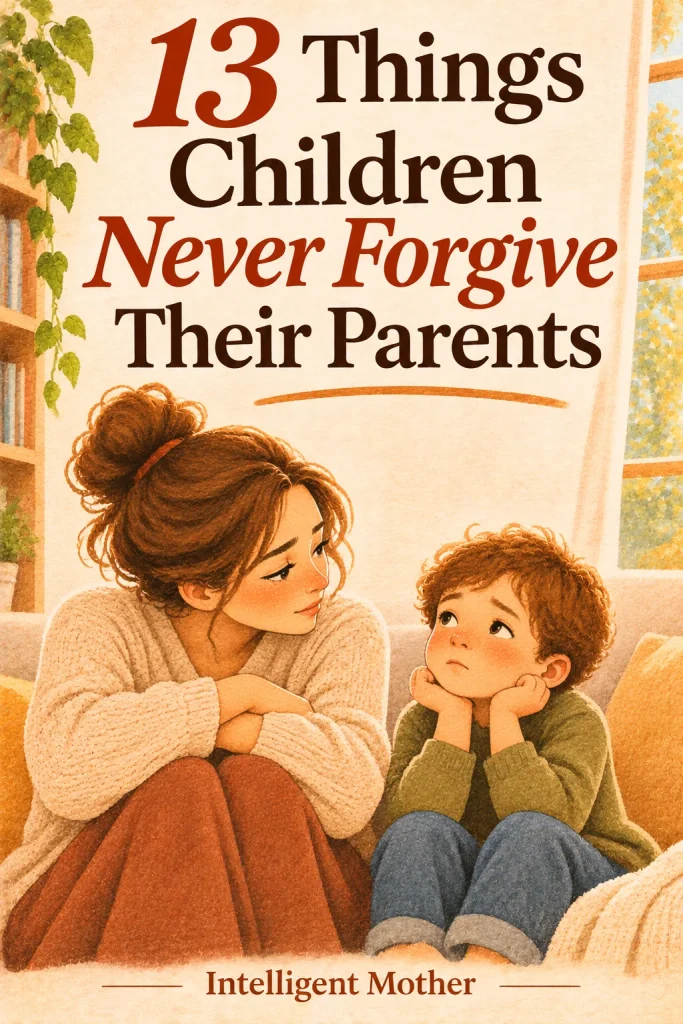
There are things parents forget the moment the bedroom door closes. But the child may go on remembering, years afterward.
A broken glass, and a scolding. A family dinner, and the grown-ups laughing because the child cried. A trip that was promised and never came. A story from school the child wanted to tell, and a mother glancing at her phone, saying, “Maybe later.”
To you, these are small things. You have a whole world to attend to. But to the child, you are the world.
Don’t misunderstand me. Not every unhappy moment becomes a wound. The child is not keeping a ledger of your mistakes, the way adults sometimes fear. One rain does not make a river. But when water runs over the same ground day after day, the ground takes a shape.
It is what is repeated that teaches. It teaches children how to see themselves, and how to see the very people who were supposed to protect them.
And there is no list that is true for every child. One adult still remembers a single sentence spoken when she was six. Another hardly remembers being punished, but cannot forget the feeling that approval always had to be earned.
This has to be understood, and understood deeply: children do not need a perfect childhood. They need to know that when something hurts them, their parents will not dismiss it, will not abandon them, and will not make them responsible for the pain.
Perfection is a demand of the ego. Love has never asked for it.
Here are thirteen things that can leave deep and lasting marks between parents and children. Don’t read them as an accusation. Read them the way you would look into a mirror.
As an Amazon Associate, Intelligent Mother earns from qualifying purchases.
Mom's Everyday Favorites
Thoughtful finds for busy days, family life, and a little time for yourself.

1. Turning Love Into a Reward
One child brings home an A and receives a hug. Another brings home a C and receives a long sigh.
You have never said, “I love you only when you do well.” You don’t need to say it. Children do not learn love from your words. They learn it from what happens after they win, and what happens after they lose.
If warmth arrives mainly when the child is obedient, successful, impressive, the child may come to a conclusion: my worth lies in keeping other people happy.
The problem is not that a child wants to do well. The problem is that the child may no longer know whether love is still there on the days of failing, disobeying, disappointing. A BEAUTY FIND Moisturizing cream for face and body with ceramides and hyaluronic acid.
CeraVe Moisturizing Cream
Behavior may need to change. Grades may need work. Responsibility remains responsibility. But love is not a medal handed to the child who crosses the finish line. Love with conditions is a bargain, and children feel that long before they can name it.
A child should not have to win to be loved. And a child should not have to fail to discover that the love was there all along.
2. Humiliating Them in Front of Others
A child spills a drink at a family gathering. The adults laugh. Somebody begins to recount all the other times the child was clumsy.
Everybody is enjoying it. Only one person is not laughing: the child, face burning, eyes fixed on the plate.
To correct a behavior is one thing. To turn a human being into a punchline is a totally different thing.
When parents regularly mock their children, give them nicknames that hurt, pass around their private stories, use their weaknesses as entertainment, children may learn a very quiet lesson: hide. And when something goes wrong, they will not come to you. A BEAUTY FIND A niacinamide serum for a simple everyday skincare routine.
The Ordinary Niacinamide 10% + Zinc 1%
It matters more as they grow. Friendships, their bodies, a first crush, a mistake at school: to them, all of this is deeply private.
You can correct a child without an audience.
3. Criticizing Without End
There are homes where everything a child does could always have been better.
The drawing is lovely, but the coloring is not neat. The room is clean, but there is one sock under the bed. The score is good, but why not perfect?
You think you are encouraging. But when criticism always arrives before acknowledgment, the child may slowly borrow your eyes to look at himself or herself. And they are eyes that only search for what is wrong.
Labels are more dangerous still. A child who breaks something is not necessarily careless. A child who fights over a toy is not selfish. A child who struggles with math is not unintelligent. A BEAUTY FIND A hydrating essence for a moisture-focused skincare routine.
COSRX Advanced Snail 96 Mucin Power Essence
In How to Talk So Kids Will Listen & Listen So Kids Will Talk, Adele Faber and Elaine Mazlish explore how labels that seem harmless can lead children to accept fixed roles in the family.
An act is an act. A person is the whole sky. Don’t name the sky after one cloud.
A poor test result is just a poor test result. It is not a verdict on who the child is.
4. Dismissing Their Feelings
A favorite toy breaks and the child cries. An adult says, “You’re crying over that?”
A friend did not invite the child to a birthday party. “It’s no big deal. You’ll forget it by tomorrow.”
The child is afraid of the dark. Somebody laughs: “You’re too old to be scared of monsters!”
You are measuring the child’s sorrow with an adult’s ruler. But a feeling is not measured by the size of the problem.
When feelings are dismissed again and again, children may begin to doubt what they feel. They learn to hide it, because they don’t want to be seen as weak, oversensitive, difficult. A BEAUTY FIND Washable mascara for everyday makeup looks.
Maybelline Lash Sensational Sky High Washable Mascara
In Good Inside, Dr. Becky Kennedy draws an important distinction: acknowledging a child’s feeling is not the same as agreeing with every behavior. You can see that your child is angry and still hold a firm boundary against hitting a sibling.
That distinction is precious. You don’t have to agree that a broken toy is a catastrophe. You only have to understand that your child is upset about it.
There is no need to shut a feeling down in order to teach a child how to behave.
5. Favoring One Child Over Another
With two children in a house, the difference shows in very small ways. One is praised for being smart; the other is told to try harder. One is forgiven quickly; the other receives a long lecture on responsibility.
You have your reasons. One child is easier to care for. One has a temperament that feels familiar to you. One is passing through a difficult time and needs more attention. A BEAUTY FIND Daily facial moisturizer with ceramide-3 and niacinamide.
La Roche-Posay Toleriane Double Repair Face Moisturizer
Fairness does not mean cutting everything into two exactly equal halves. But children need to feel that they are not competing for their parents’ love.
You cannot guarantee that siblings will never be jealous of each other. But you can refuse to turn the family into an arena where the prize is your approval.
6. Breaking Their Trust
A child whispers to her mother that she has a crush on someone at school. She has looked around first, to be sure nobody is listening. As an Amazon Associate, Intelligent Mother earns from qualifying purchases. Thoughtful picks related to this article.Helpful products to explore

A few days later, the secret is sitting in the middle of the dinner table. Everybody laughs. The adults find it adorable. And the child does not share anything more.
Trust is not built only through big promises. It is built through the way you hold the small things your child has chosen to give you.
Of course there are times when a parent must share something to protect a child: when there are concerns about abuse, exploitation, or a serious health issue. But that is a very different thing from turning a harmless secret into family entertainment. And when you must share, whenever possible, tell the child why, and who needs to know. A BEAUTY FIND Moisturizing cream for face and body with ceramides and hyaluronic acid.CeraVe Moisturizing Cream
When a child opens up, something very fragile is being placed in your hands. Let home be the safe place where difficult things can first be said.
7. Promising, and Forgetting, Again and Again
“We’ll go to the park this weekend.”
“Dad will be there to watch your performance tomorrow.”
“Once work slows down, I’ll play with you.”
A promise is easy to make. And often you sincerely mean it. Then work piles up, a meeting runs late, something urgent pushes in. And the child is sitting at home on the very afternoon that was awaited the whole week.
One broken promise does not destroy trust. Life is like that; some things are beyond your hands. But when promising and forgetting becomes a habit, your words may grow lighter and lighter in the child’s ears. A BEAUTY FIND A niacinamide serum for a simple everyday skincare routine.The Ordinary Niacinamide 10% + Zinc 1%
Don’t promise much. One promise kept is worth more than ten promises made only to make a child happy for a few minutes.
And when you cannot keep your word, go back and explain what happened. Don’t behave as if the child had not been waiting.
8. Ruling Through Fear
A child stops crying when an adult raises a hand. The toys are put away immediately after the shouting. A threat is spoken, and the child falls silent.
You think the child has understood. But silence is not always understanding. Sometimes the child is simply learning how to avoid someone who is frightening.
Discipline exists to help children understand boundaries, responsibility, and the consequences of what they do. When fear becomes the main tool, the child may think only of escaping punishment, and never see how the behavior touches other people.
Fear can create obedience. It does not create understanding. A BEAUTY FIND A hydrating essence for a moisture-focused skincare routine.COSRX Advanced Snail 96 Mucin Power Essence
The American Academy of Pediatrics recommends against spanking, threats, insults, humiliation, or shame as methods of discipline. These approaches are not effective ways of building positive behavior over the long term, and they are associated with unfavorable behavioral, emotional, and psychological outcomes.
That does not mean letting children do whatsoever they want. You still have to set boundaries. You still have to stop your child from hurting someone, keep your child safe, and teach responsibility when actions have consequences.
But you do not need to hurt a child to teach that hurting others is wrong.
9. Putting Adult Burdens on Small Shoulders
Some children can tell how their parents are feeling just from the sound of the front door opening. As an Amazon Associate, Intelligent Mother earns from qualifying purchases. Thoughtful finds for busy days, family life, and a little time for yourself.Mom's Everyday Favorites


No asking for a toy today, because Dad is in a bad mood. No crying, because Mom is already exhausted. And whenever the parents argue, the child steps in as the peacemaker.
Children can learn independence, help around the house, care about other people. These are beautiful qualities. But giving a child responsibilities that fit the age is one thing. Asking a child to carry emotional weight that is too heavy is another. A BEAUTY FIND Washable mascara for everyday makeup looks.Maybelline Lash Sensational Sky High Washable Mascara
Children should not have to comfort their parents after every argument, take sides in a failing marriage, or feel that it is their job to hold the family together.
When a child regularly puts the adults’ needs ahead of his or her own, childhood can begin to feel like a job the child does not know how to quit.
Let your child care about the family. But the happiness of your marriage is your business. That is an adult responsibility.
10. Not Protecting Them When They Need You
A child says there is bullying at school. The adults say: toughen up.
A child says someone is making them uncomfortable. The parents assume it is imagination.
A child turns to an adult after being mistreated, and receives a question in return: “What did you do to cause it?”
You cannot prevent every bad thing. You cannot control everyone your child meets, every situation, every danger out there. Nobody is asking that of you.
But when a child comes to you, what matters is whether you listen, and whether you act to protect. A BEAUTY FIND Daily facial moisturizer with ceramide-3 and niacinamide.La Roche-Posay Toleriane Double Repair Face Moisturizer
Research on adverse childhood experiences shows that violence, abuse, and neglect can have lasting effects on health and development. And stable, responsive relationships with caregivers can help buffer the effects of stressful experiences.
Don’t let a child have to prove that the suffering was enough before an adult will believe it.
Begin by listening, understanding, protecting. Don’t begin by searching for reasons to defend the person who caused the hurt.
11. Never Saying Sorry
There is something very strange in many families: the children are expected to apologize when they are wrong, and the adults rarely do.
The child says something hurtful, and the child must apologize. But when a parent yells, calls names, overreacts, the conversation often ends with a command: “Stop arguing!”
You are afraid that apologizing will weaken your authority. Consider the opposite.
An adult who admits a mistake is still a responsible parent. An apology does not erase your place in the family. It shows the child that in this house everyone is accountable for how they treat other people, the adults included. A BEAUTY FIND Moisturizing cream for face and body with ceramides and hyaluronic acid.CeraVe Moisturizing Cream
In Good Inside, Dr. Becky Kennedy emphasizes reconnecting after a parent loses their temper: the parent takes responsibility for their own behavior, rather than telling the child that the child caused the anger.
The anger is yours. Don’t hand it to the child and say it is theirs.
You don’t need to explain how tired you were in order to justify a hurtful word. You can admit you were wrong. You can apologize. And more important, you can work on responding differently the next time.
12. Comparing
“Look at your friend. Why can’t you be more like them?”
“Your older sister could do all of this at your age.”
“Other people’s children are smart and well-behaved. Why do I have to keep reminding you?”
These sentences slip out in a moment of frustration. You believe a little comparison will make the child try harder.
But children do not always hear the message you intend to send. You say, “You can improve.” The child may hear, “I am not as good as everyone else.”
Compared constantly, a child may begin to see another’s success as proof of his or her own shortcoming. The child stops looking at how far they have grown, and starts measuring a position in a race they never agreed to enter. A BEAUTY FIND A niacinamide serum for a simple everyday skincare routine.The Ordinary Niacinamide 10% + Zinc 1%
The siblings are pulled in too. One becomes the smart one. Another becomes the troublemaker, or the one who is bad at school. In time, the family members see each other through these roles.
The rose does not compare itself with the lotus. Every child has their own pace, their own strengths, their own struggles.
You can still help your child set goals and work hard. But the best measure is how far the child has come, not where the child stands beside another.
13. Making Them Responsible for Your Happiness
Some words come out when parents are hurt or overwhelmed:
“I’ve sacrificed everything for you.”
“If it weren’t for you, our lives wouldn’t be this difficult.”
“You make me so unhappy. I don’t feel like doing anything anymore.”
Perhaps you do not intend to make your child feel guilty. Perhaps it is only the voice of exhaustion, of disappointment, of the feeling that your sacrifices have gone unnoticed.
But on a child’s shoulders, these words are enormously heavy.
The child may come to believe they must behave perfectly to keep Mom happy, get good grades to make Dad proud, give up their own wishes so the family won’t be disappointed. Even the ordinary choices of childhood, like wanting to be with friends or disagreeing with a parent, can come with the feeling of letting someone down. A BEAUTY FIND A hydrating essence for a moisture-focused skincare routine.COSRX Advanced Snail 96 Mucin Power Essence
Teaching children to appreciate what their family does for them is one thing. Making them feel indebted for having been born is another.
You can tell your child that you are tired, that you are sad, that you need help. Children can also learn to care about other people’s feelings. But they should not have to carry the task of keeping the adults happy.
Gratitude opens like a flower. Debt presses down like a stone. Let your child grow up with gratitude, loving the family, and still allowed their own wishes, their own feelings, their own life.
Can What Is Broken Be Repaired?
Having read this far, you may be remembering moments you are not proud of.
A time you yelled over something small. A time you compared your child with a sibling. A promise forgotten. A moment you were not listening, exactly when your child needed you most.
If so, don’t sit there and conclude that you have ruined your child’s childhood. Guilt does not help the child. It only turns you back toward yourself.
One mistake does not by itself define a whole relationship. What matters is what happens after the mistake.
You can come back. Acknowledge what happened. Listen to what your child feels. Show that you are willing to behave differently. A BEAUTY FIND Washable mascara for everyday makeup looks.Maybelline Lash Sensational Sky High Washable Mascara
A long, elaborate apology is not needed. What is needed is an apology that does not blame the one who was hurt.
And don’t demand to be forgiven immediately. Forgiveness is not a duty children must perform so their parents can feel better. It cannot be demanded. It can only come on its own.
If the hurt has lasted for years, rebuilding trust may take time, consistent action, and sometimes the support of a qualified professional.
But a relationship does not have to end at its worst moment.
Childhood Is Woven From Ordinary Days
Childhood is not made only of family vacations, birthday presents, and celebrations. It is woven on very ordinary afternoons.
When a child breaks a glass and knows the truth can still be told. When a child cries and is not mocked. When a child makes a mistake and is guided, rather than called useless. When a parent breaks a promise, but comes back, explains, and tries to make it right.
You cannot protect your child from every disappointment. And perhaps you should not try. Children need to learn to face frustration, boundaries, and things that do not go their way. A BEAUTY FIND Daily facial moisturizer with ceramide-3 and niacinamide.La Roche-Posay Toleriane Double Repair Face Moisturizer
But one thing is worth preserving: the feeling that even when the world outside is not always kind, home is still a place to return to without pretending to be perfect.
Your child will not remember that you never made a mistake. One can only hope that, looking back someday, your child will not have to wonder whether they were worthy of being loved.
The greatest gift is not a childhood without pain.
It is a relationship safe enough for hurt to be acknowledged, heard, and healed.
Questions and Answers
The first question: What hurts children the most emotionally?
There is no single experience that affects every child the same way. But repeated humiliation, neglect, rejection, criticism, and growing up in an unsafe environment can seriously affect a child’s emotional development and mental well-being.
The second question: Can parents hurt their children without realizing it?
Yes. Many harmful patterns do not come from bad intentions. Repeatedly dismissing feelings, criticizing, punishing harshly, or neglecting a child’s needs can leave a mark even when parents believe they are doing what is best. To see the pattern is the first step toward changing it.
The third question: Can a damaged relationship be repaired?
In many cases, yes. Repair begins with acknowledging what happened, taking responsibility without excuses, listening to the child’s experience, and showing change through consistent action. Forgiveness should never be demanded. A BEAUTY FIND Moisturizing cream for face and body with ceramides and hyaluronic acid.CeraVe Moisturizing Cream
The fourth question: Do children remember the hurtful things their parents say?
Children differ in what they remember and in how they understand their experiences. A single incident does not decide a child’s future. But repeated experiences of humiliation, rejection, or criticism can shape how children see themselves and their relationships. As an Amazon Associate, Intelligent Mother earns from qualifying purchases. Thoughtful picks related to this article.Helpful products to explore

The fifth question: Is it too late to apologize to an adult child?
Not necessarily. A sincere apology can open the door to a conversation, even after many years. Give your attention to understanding your child’s experience, rather than waiting for immediate forgiveness or reconciliation.
As an Amazon Associate, Intelligent Mother earns from qualifying purchases.
Mom's Everyday Favorites
Thoughtful finds for busy days, family life, and a little time for yourself.