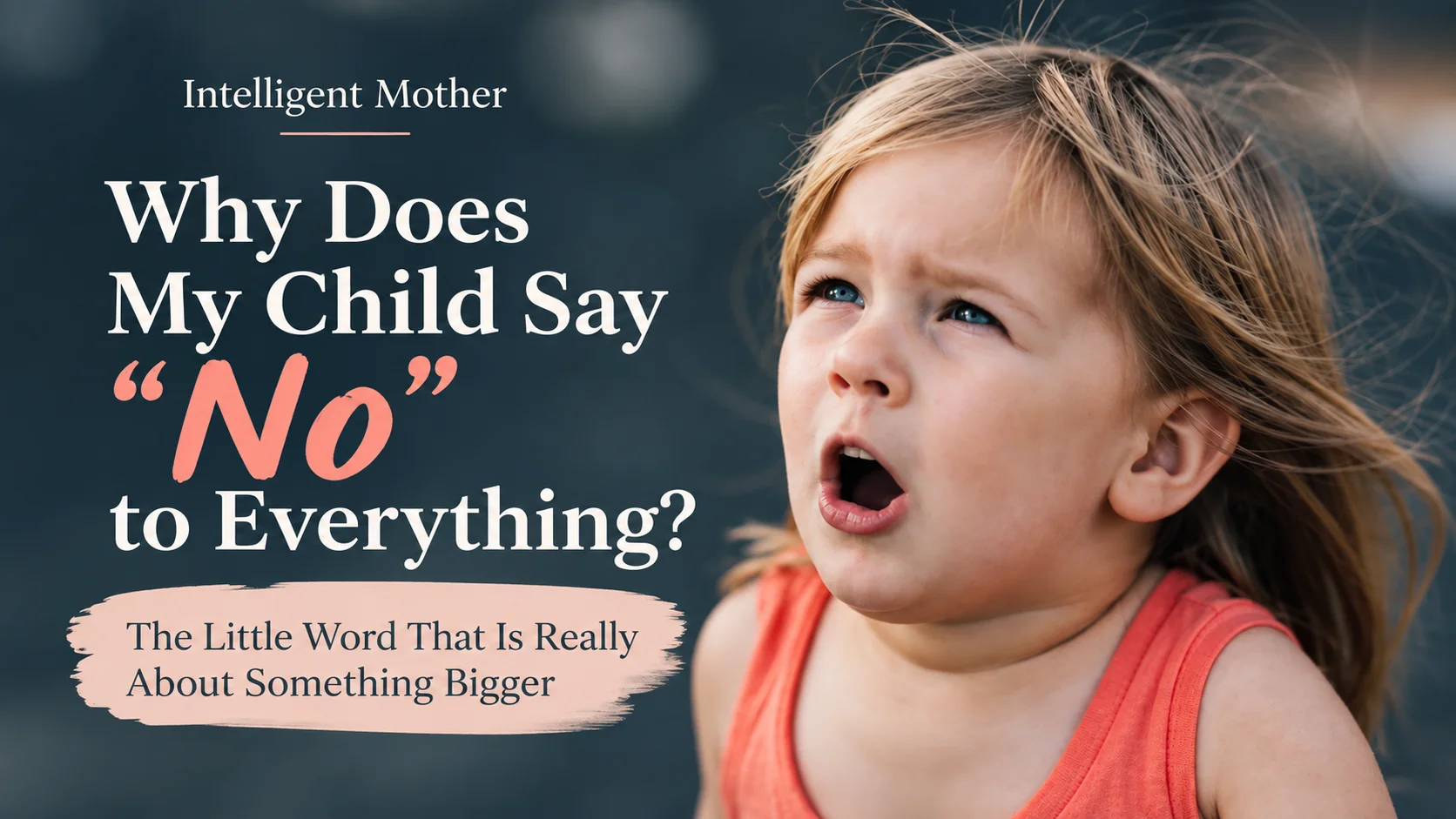
Why Does My Child Say “No” to Everything?
The Little Word That Is Really About Something Bigger
There is a stage in childhood when the word “No” seems to arrive before you have even finished your sentence.
“Laura, it’s time to get dressed.”
“No.”
“Can you brush your teeth?”
“No.”
“Do you want to put your shoes on?”
“No.”
“Would you like a banana?”
“No.”
At some point, you start wondering whether your four-year-old has discovered a new word or simply decided to build her entire personality around it.
I remember standing in the middle of the bedroom one morning, holding Laura’s shirt in one hand while she sat on the floor with her little toy car in the other. We were already running late. She had heard every request I had made that morning, and somehow every single one had received the same answer.
“No.”
And if I am honest, what bothered me most was not the word itself.
It was what I started telling myself about it.
She never listens to me.
She is deliberately making everything difficult.
If I let this go, she will think she can always get her way.
Suddenly, putting on a shirt was no longer about a shirt.
It was about who was in charge.
And that is how an ordinary morning can turn into a tiny family power struggle before anyone has even finished breakfast.
Maybe You Know This Kind of “No”
You ask your child to put her toys away.
“No.”
You remind her that it is time to leave the playground.
“No.”
You ask her to take a bath.
“No.”
You tell her it is time to get dressed.
“No.”
Sometimes Laura would say it with a smile, almost as if she knew exactly how much that one little word could annoy me.
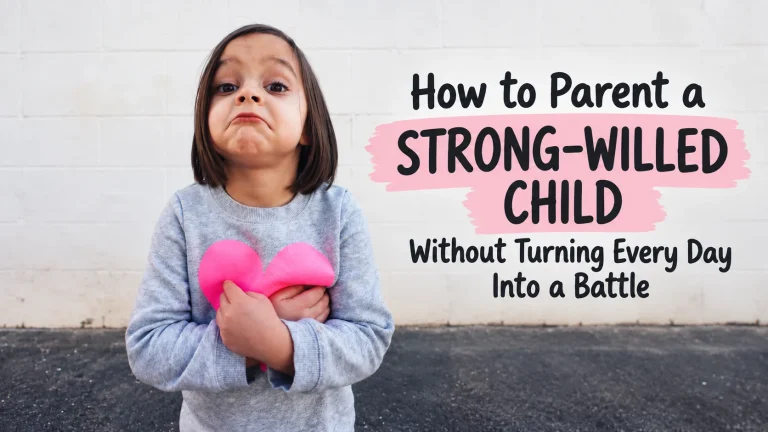
Other times, there was no smile at all. She would cross her arms, turn her body away from me, and say it with such certainty that I could almost feel my patience leaving the room.
I used to hear those moments as rejection.
She is refusing me.
But gradually, I started wondering whether I was listening to the word and missing the child behind it.
Because what does a four-year-old actually mean when she says “No”?
Sometimes she really means, I don’t want to do that.
Sometimes she means, I want to decide this myself.
Sometimes she means, I was having fun and I don’t want it to end.
Sometimes she is tired, hungry, overwhelmed, deeply absorbed in what she is doing, or simply testing where the boundary is.
And sometimes, she just does not like the answer.
That last one is important too.
Not every “No” has a hidden psychological meaning.
Sometimes a child simply does not want to put on the blue shirt.
A Four-Year-Old Can Understand You and Still Resist You
One of the hardest things for me to remember was that understanding a request and willingly doing it are two different things.
Laura could understand what I was saying.
She knew what “time to clean up” meant. She knew what “we have to leave now” meant. She knew that pajamas came before bedtime.
But knowing the rule did not automatically make following it easy.
A four-year-old is still learning how to manage impulses, frustration, disappointment, and the strong desire to do things independently. The part of the brain involved in self-control is still developing, and emotions can easily become bigger than a child’s ability to manage them in the moment.
Adults sometimes forget how strange this must feel from the child’s side.
Imagine being deeply absorbed in a book and suddenly someone closes it and says, “We’re leaving.”
You might understand perfectly well that you need to go.
You might even agree that you need to go.
But you would probably still feel annoyed.
For Laura, the toy car on the floor could matter far more than it looked from where I was standing.
So when I said, “Come on, it’s time for a bath,” I was thinking about the schedule.
She was thinking about the car.
Neither of us was necessarily wrong.
We were simply standing inside two completely different versions of the same moment.
Then I Realized I Was Asking Too Many Questions
There was another thing I began noticing.
I was giving Laura too many opportunities to answer with “No.”
“Do you want to get dressed?”
“Do you want to brush your teeth?”
“Do you want to come to the table?”
“Do you want to put your shoes on?”
Of course, sometimes I genuinely wanted to give her a choice.
But sometimes I was asking a question when there really wasn’t a choice.
We had to leave.
She had to get dressed.
It was bedtime.
And when I asked, “Do you want to get dressed?” I was surprised when she answered honestly.
“No.”
I had accidentally turned a simple instruction into a negotiation.
So I started changing the way I offered choices.
Instead of, “Do you want to get dressed?” I would say, “Do you want the blue shirt or the yellow one?”
Instead of, “Do you want me to help you?” I might say, “Do you want to put your shirt on yourself, or do you want me to help?”
Instead of, “Do you want to wear your shoes?” I could say, “Shoes or sandals?”
The decision was still hers.
But the boundary remained mine.
That small difference changed many ordinary moments in our day.
But Sometimes Laura Still Said “No”
Even after I learned to offer better choices, Laura still said no.
Of course she did.
There is no magic sentence that makes a four-year-old suddenly become agreeable.
Sometimes she would look at the two shirts I offered and say, “Neither.”
Sometimes she would choose the blue shirt, put it on, and then immediately decide she hated blue.
Sometimes she would lie on the floor because she did not want to leave the playground, even though we had already talked about leaving.
And this was where I had to learn something much harder than giving choices.
I had to learn that Laura was allowed to disagree with me.
She was allowed to be unhappy.
She was allowed to cry.
She was allowed to say, “I don’t want to.”
What she was not allowed to do was hit me, hurt someone else, or ignore a necessary safety boundary.
Her feelings could be big.
My boundary could still be firm.
I could say, “I know you don’t want to leave. You really wanted to keep playing. But it is time to go.”
She might still cry.
That did not mean I had failed.
It simply meant she was disappointed.
And disappointment is something children eventually have to learn how to carry.
I Used to Think I Had to Make Her Stop Saying “No”
For a long time, I thought good parenting meant getting Laura to cooperate.
The quieter the morning, the better.
The fewer arguments, the better.
The faster she followed my instructions, the better.
But somewhere along the way, I started asking myself a different question.
What if my goal isn’t to make her stop saying “No”?
What if my job is to help her learn how to use that word well?
Laura needs to know that she can say:
“I don’t like that.”
“I want to do it myself.”
“I need help.”
“I’m not ready.”
“I’m angry.”
Those are valuable things for a child to learn how to express.
But she also needs to learn that having a voice does not mean always getting her way.
Sometimes Mom says no.
Sometimes Dad says no.
Sometimes the answer is no because it is unsafe.
Sometimes the answer is no because another person has a need too.
Sometimes the answer is simply no because families cannot organize their entire day around one person’s wishes.
That is not a punishment.
It is part of learning how to live with other people.
Then I Started Hearing a Different “No”
One evening, Laura was lining up her toy cars across the living room floor.
It was bath time.
“Laura, it’s time for a bath.”
“No.”
My old reaction would have been immediate.
“Laura, I already told you. Come on.”
Instead, I sat down beside her.
“You really don’t want to stop playing.”
“No.”
“You want to finish your cars first.”
She nodded.
So I said, “You can have two more minutes, and then we are going to take a bath.”
She looked at me.
“No.”
I almost laughed.
But this time, I didn’t hear her “No” as a challenge.
I heard, I’m not ready to stop.
That was different.
The boundary had not changed.
Bath time was still happening.
But the battle didn’t have to happen with it.
I could understand why she was upset without changing the answer.
And perhaps that is one of the most useful things I have learned about parenting a four-year-old.
Understanding is not the same as giving in.
The Hardest Part Was Not Laura’s “No”
The hardest part was what I did with it inside my own head.
Sometimes Laura would refuse something, and within seconds I would feel disrespected.
Why won’t she just listen to me?
Am I being too soft?
Does she think she can control me?
Why is everything so difficult?
But Laura didn’t know any of those stories.
She didn’t know I was wondering whether I was a good mother.
She didn’t know I was worried about losing authority.
She didn’t know that her refusal had somehow become a judgment about my parenting.
She knew only that she did not want to leave the playground.
Or she wanted to wear the other dress.
Or she wanted five more minutes with her toys.
The rest was the story I was telling myself.
And sometimes that story was making the moment much bigger than it needed to be.
I Started Listening Differently
Now, when Laura says “No,” I try to pause before deciding what it means.
Is she tired?
Is she hungry?
Is she deeply involved in something?
Did I suddenly interrupt her without warning?
Does she want to do it herself?
Is she testing a boundary?
Or does she simply not want to?
I don’t always get it right.
Sometimes I am tired too.
Sometimes the clock is ticking and there is absolutely no room for a philosophical conversation about why Laura does not want to put on her socks.
That is real life.
But when she is already overwhelmed, arguing usually doesn’t teach her much.
Sometimes fewer words work better.
I stay close.
I keep her safe.
I hold the boundary.
And I let the storm pass without turning it into a courtroom debate.
A four-year-old does not need a twenty-minute explanation while she is in the middle of a meltdown.
Sometimes she needs a calm adult who can say, “I know. You really don’t like this. I’m here.”
There Is One Kind of “No” I Still Want Her to Keep
I don’t want Laura to grow up believing that being a good girl means always saying yes.
I want her to know that her voice matters.
I want her to be able to say no when something feels wrong.
I want her to tell me when she disagrees.
I want her to ask questions.
I want her to know that she can have an opinion even when the person she loves does not share it.
But I also want her to learn something equally important.
Freedom does not mean that every answer has to be yes.
Sometimes she will have to put on the coat because it is cold.
Sometimes she will have to leave the playground because we need to go home.
Sometimes she will have to sit in the car seat even when she doesn’t feel like it.
She can cry about it.
She can be angry about it.
She can tell me she thinks it is unfair.
And I can still hold the boundary.
Her feelings are welcome. The boundary is still there.
That is not a contradiction.
Perhaps that is what healthy boundaries often look like with young children.
Gentle and firm at the same time.
Then One Day, I Realized the “No” Had Changed
It wasn’t Laura’s “No” that had changed.
Mine had.
I had stopped hearing her refusal as a personal attack.
I stopped automatically thinking, She is making this difficult.
Sometimes I heard something different.
I want to have a say.
I want to do it myself.
I don’t like this.
I’m disappointed.
I’m still learning where I end and other people begin.
And that last part stayed with me.
Because perhaps this is one of the quiet jobs of childhood.
A child is slowly discovering that she is a separate person.
She has preferences.
She has opinions.
She has limits.
She can influence the world around her, but she cannot control all of it.
And our job as parents is not to erase that emerging voice.
It is to help a child learn how to use it.
The Blue Shirt
The next morning, I held up two shirts.
“The blue one or the yellow one?”
Laura looked at both.
“The blue one.”
I handed it to her.
She put it on.
Then she looked down at herself for a few seconds.
“I want the yellow one.”
I stood there for a moment.
The old me might have sighed.
The new me almost laughed.
“Okay,” I said. “Let’s change.”
She smiled and ran off to get the yellow shirt.
She is four.
She is still learning what it means to have a voice.
She is still learning that other people have voices too.
She is still learning that sometimes she gets to choose, and sometimes Mom chooses.
And I am still learning how to hear the difference between a child saying “No” because she needs a voice and a child saying “No” because she simply doesn’t like the answer.
Maybe that is what this little word was trying to teach me all along.
“No” is not always a door slammed in my face.
Sometimes it is just a small child turning toward me and saying,
“Mom, I’m here. I have a voice too.”
And perhaps my job is not to make that voice disappear.
It is to help Laura learn how to use it, while letting her know that no matter how many times she says “No”…
Mom is still here.