Why Sensory Play Is So Good for Toddlers: 7 Benefits Parents Often Miss
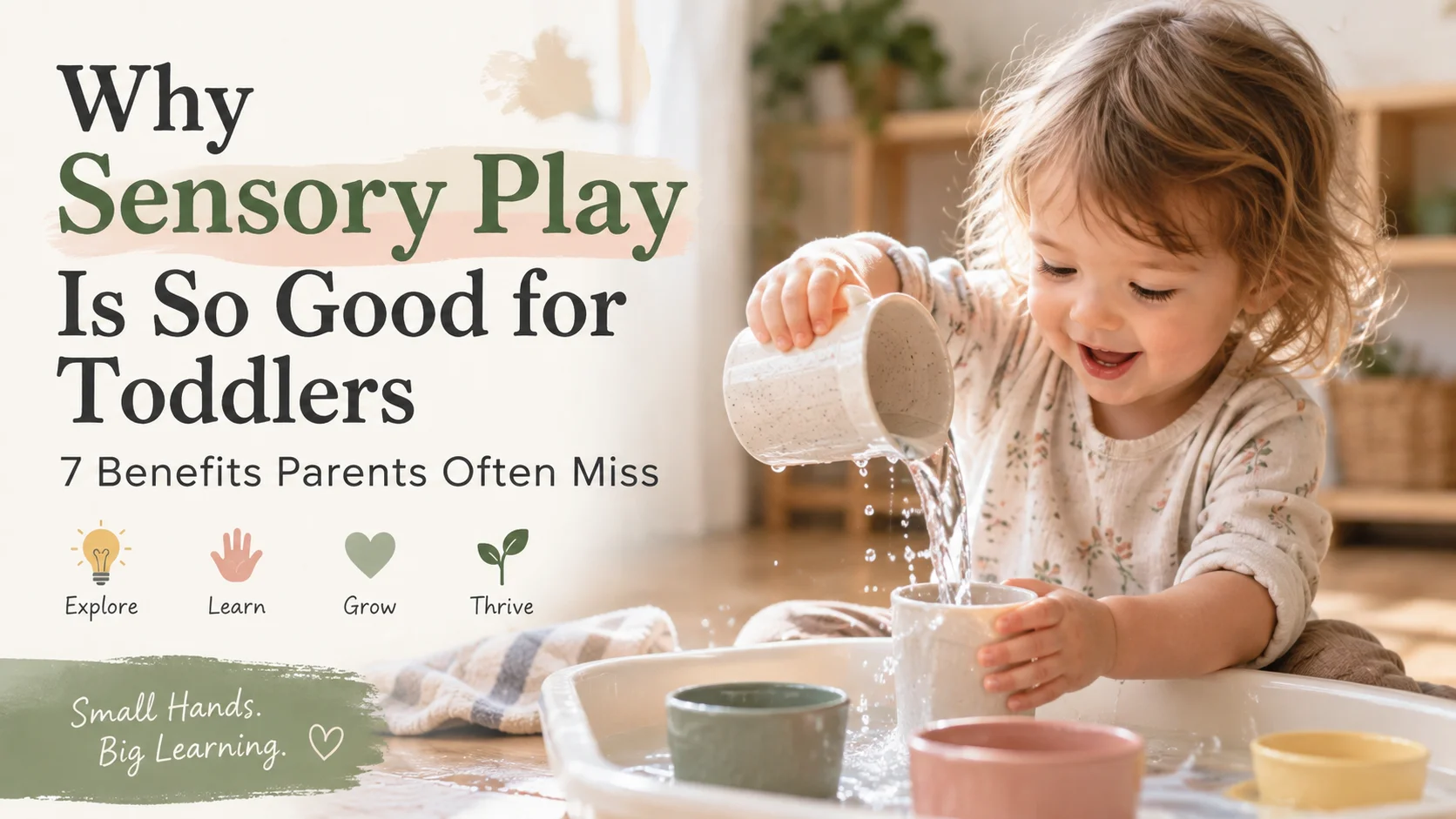
There is something strangely fascinating about watching a toddler play with water.
Give them a cup, a bowl, and a little water, and they can stay there for what feels like an eternity.
Scoop.
Pour.
Splash.
Pour again.
Then, for reasons known only to toddlers, pour the entire thing onto the floor.
You may look at the scene and think, Well, that was five minutes of my life.
Your toddler may be thinking something much more important:
What happens if I pour it from here?
Why does the cup feel heavier now?
Where did the water go?
What happens if I do it again?
This is sensory play.
And while it can look wonderfully simple, there is a lot happening underneath that little pair of busy hands.
Sensory play gives young children opportunities to explore the world through touch, movement, sound, sight, smell, and sometimes taste. More importantly, it gives them a chance to experiment with cause and effect, movement, language, problem-solving, and control.
Researchers and pediatric experts have long recognized the broader developmental value of play. The American Academy of Pediatrics, for example, describes play as an important part of children’s cognitive, physical, social, and emotional development.
But there is an important distinction worth making.
Not every sensory activity is a magical brain-building exercise. And sensory play should not be treated as therapy simply because it involves sensory experiences.
Sometimes a child is just playing.
And that is already doing a lot.
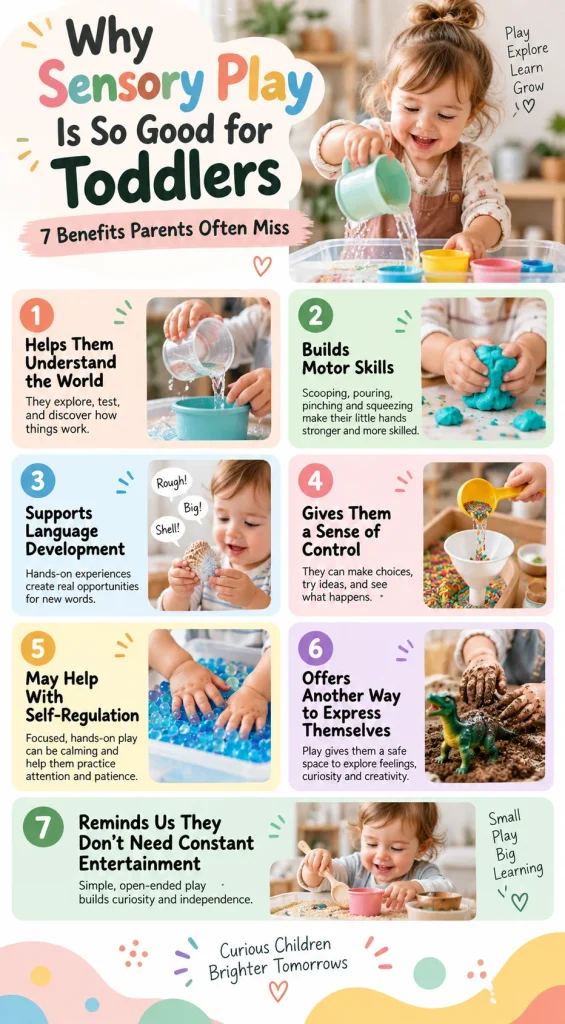
Here are seven benefits of sensory play that are easy to miss.
1. Sensory play helps children learn how the world works
Toddlers are basically tiny scientists with very questionable laboratory safety standards.
They drop things.
They squeeze things.
They stack things.
They throw things.
They put things into other things.
And then they repeat the experiment approximately 47 times.
Why?
Because repetition helps them figure out how the world behaves.
When a toddler pours water from one container into another, they are not simply making a mess. They are noticing that the same amount of water can look different depending on the container.
When they squeeze play dough, they discover that pressure changes its shape.
When they bury a toy in sand and dig it back out, they experience something disappearing and reappearing.
When they drop a spoon into a bowl, they hear a sound.
Drop it again?
Same sound.
Again?
Apparently, this deserves further investigation.
This kind of play gives children direct experience with cause and effect.
They do something.
Something happens.
They change what they do.
Something changes.
That is a surprisingly powerful way to learn.
Young children learn through their bodies long before they can explain what they have learned with words.
2. It turns little hands into powerful learning tools
We often think of learning as something that happens in the head.
For toddlers, a lot of learning starts somewhere else.
In their hands.
Picking up objects, squeezing, scooping, pinching, pouring, stirring, pushing, pulling, and transferring materials all give children opportunities to practice different kinds of hand and finger movements.
A toddler scooping rice into a cup is working on more than the obvious goal of getting rice into the cup.
They are coordinating their eyes and hands.
They are adjusting how much force to use.
They are learning how an object moves through space.
They are practicing control.
And when they spill half of it?
They get another opportunity to try.
This is one reason simple activities can be surprisingly valuable.
A bowl of water and a few cups may offer more hands-on learning than an expensive toy with twelve buttons, three flashing lights, and a battery compartment that somehow always ends up under the sofa.
The point is not that toys are bad.
It is that children do not always need more stimulation.
Sometimes they need something they can actually do.
3. Sensory play can open the door to language
Toddlers do not always need a flashcard to learn a new word.
Sometimes they need a handful of something squishy.
Imagine your child playing with homemade dough.
You say:
“Soft.”
They squeeze it.
“Squishy.”
They squeeze it again.
“Sticky.”
They pull their fingers away.
Now the words are connected to an actual experience.
The child is not simply memorizing a label.
They are feeling what “soft” means.
They are seeing what “wet” looks like.
They are hearing what “loud” sounds like.
They are noticing that something can be “heavy” or “light,” “hot” or “cold,” “rough” or “smooth.”
Sensory play creates countless opportunities for this kind of language.
You can talk about what your child is doing without turning the activity into a vocabulary lesson.
“You’re pouring the water.”
“That one is full.”
“Now it’s empty.”
“You found the red spoon.”
“You made a big splash.”
That last sentence may be met with an even bigger splash.
This is how language often grows in early childhood: attached to things that matter to the child in that moment.
4. It gives children control over a small world
Toddlers spend much of their day being told what happens next.
It’s time to get dressed.
Time to eat.
Time to leave.
Time to wash your hands.
No, we are not taking the entire park home with us.
Adults control most of the environment.
Sensory play gives children a small space where they can make things happen themselves.
They can decide how much sand to scoop.
Which cup to fill.
Where to put the toy.
How hard to squeeze.
Whether to mix the colors.
Whether to start all over again.
That sense of agency matters.
Play researchers have long emphasized the importance of children’s ability to make choices and act on their environment. Play is one of the places where children can experience themselves as capable people rather than simply recipients of adult instructions.
This does not mean giving toddlers complete freedom.
They still need boundaries.
Water stays in the container.
Sand does not go in the mouth.
The cat is not part of the experiment.
But within those boundaries, let them make some decisions.
Sometimes the most valuable part of an activity is not what the child creates.
It is the feeling:
I did that.
5. It may help children practice self-regulation
This is where we need to be a little careful.
You will often hear claims that sensory play “regulates the nervous system” or that certain sensory activities automatically calm children.
The science is more complicated than that.
Sensory-based interventions have been studied, particularly for children with developmental differences, but the quality and consistency of the evidence vary. Some specific approaches show promise, while it would be an overstatement to say that every sensory activity has a predictable calming effect.
Still, ordinary play can give children opportunities to practice something closely related to self-regulation.
They have to slow down.
Coordinate movements.
Wait for something to happen.
Notice what their body is doing.
Try again after something goes wrong.
Consider a toddler trying to transfer water with a small spoon.
Too fast, and the water spills.
Too much, and the spoon becomes difficult to carry.
Too little, and the trip feels pointless.
The child adjusts.
Again.
And again.
That tiny process of noticing, adjusting, and trying again is part of learning to manage actions and attention.
It is not therapy.
It does not need to be.
It is simply practice.
6. Sensory play gives children another way to express themselves
Sometimes toddlers have a lot going on inside them and very few words available to explain it.
They may be tired.
Frustrated.
Overexcited.
Curious.
A little overwhelmed.
Or simply having a very serious disagreement with the existence of pants.
They cannot always tell us what is happening.
Play can become another language.
A child may repeatedly squeeze, pour, pound, stir, or move objects around.
They may become deeply absorbed in a repetitive activity.
They may create a little world and control everything inside it.
This does not mean we should analyze every scoop of rice as a psychological message.
Please don’t.
Sometimes a scoop of rice is just a scoop of rice.
But play can give children a safe space to explore feelings, movement, control, and curiosity when spoken language is still developing.
And when a parent sits nearby, watches, and occasionally joins in, the child also gets something else:
connection.
Harvard’s Center on the Developing Child describes play and responsive interactions as important opportunities for building skills such as attention, working memory, self-control, and communication.
The activity matters.
But the relationship around the activity matters too.
7. It reminds us that children do not need constant entertainment
This may be my favorite benefit.
Because sensory play can be wonderfully boring.
And that is exactly the point.
A toddler does not need a new activity every seven minutes.
They do not need a Pinterest-worthy invitation to play.
They do not need twelve beautifully labeled containers arranged on a wooden tray.
Sometimes they need a bowl.
A spoon.
Some water.
And enough time to discover something for themselves.
When we constantly entertain children, we can accidentally teach them that play always comes from somewhere outside themselves.
Sensory play can work in the opposite direction.
Here are the materials.
Here is the space.
Now see what you can do.
This kind of open-ended play leaves room for curiosity.
And curiosity tends to become much more interesting when nobody tells the child what the answer is supposed to be.
You Don’t Need an Expensive Sensory Play Kit
This is another place where parenting can become unnecessarily complicated.
You do not need a room full of Montessori-looking wooden objects.
You probably already have enough things at home to create simple sensory experiences.
Try:
- Water and plastic cups for scooping and pouring
- Play dough for squeezing, rolling, and shaping
- Dry rice or pasta for supervised scooping and transferring
- Ice cubes for exploring temperature and melting
- Sponges and water for squeezing
- A bowl of leaves, pinecones, or other safe natural objects for outdoor exploration
- Homemade “mud” using safe, edible ingredients
- Large containers for filling, emptying, and transferring
- A tray with different textures to touch and describe
The activity does not have to look impressive.
In fact, the less impressive it looks to an adult, the more interesting it may be to a toddler.
A cardboard box has survived generations of children’s toy preferences for a reason.
Don’t Turn Sensory Play Into Another Lesson
There is a temptation, especially when we know that play supports development, to turn every activity into an educational opportunity.
We start asking questions.
“What color is that?”
“How many are there?”
“What happens when you mix them?”
“Can you find the blue one?”
“What shape is this?”
And suddenly the child who was happily playing is sitting in a surprise examination.
You do not have to do that.
Sometimes the best thing you can say is:
“You’re really concentrating.”
Or:
“That water went everywhere.”
Or simply nothing.
Watch.
Follow your child’s attention.
Let them repeat something that seems pointless to you.
Children often know how to play long before adults remember how to leave them alone while they do it.
A Small Safety Note
Sensory play should always match your child’s age and developmental stage.
Young children still explore the world with their mouths, so small objects can pose a choking risk. Be especially careful with dry grains, beans, beads, small toys, and anything that can fit into a child’s mouth.
Water beads are particularly important to avoid around young children because they can be dangerous if swallowed.
And with water play, always stay within arm’s reach of young children. A small amount of water can become a serious drowning hazard.
Sensory play is supposed to create curiosity, not an emergency.
Keep it simple.
Keep it supervised.
The Real Magic May Be How Little You Have to Do
There is something almost countercultural about sensory play.
It asks us to slow down.
To stop trying to make every minute productive.
To let children touch things, repeat things, spill things, and occasionally make a spectacular mess.
And perhaps most importantly, it reminds us that development does not always look like learning.
Sometimes it looks like a toddler sitting on the kitchen floor, completely absorbed in moving water from one cup to another.
Nothing impressive is being produced.
No worksheet is being completed.
Nobody is winning an award.
But a child is noticing.
Testing.
Moving.
Choosing.
Repeating.
Discovering.
And maybe, for a few quiet minutes, learning that the world is a place worth investigating.
That is enough.
More than enough, actually.
FAQ: Sensory Play for Toddlers
What is sensory play?
Sensory play is play that encourages children to explore materials and experiences through their senses, including touch, sight, sound, smell, movement, and sometimes taste. Common examples include playing with water, sand, dough, ice, natural materials, or different textures.
What age can children start sensory play?
Sensory exploration begins in infancy, although the activities should change as children develop. For toddlers, simple activities involving water, large safe objects, dough, textures, and supervised scooping or pouring can work well.
Does sensory play help with child development?
Yes, sensory play can support many aspects of development because it gives children opportunities to explore, move, experiment, communicate, solve simple problems, and make choices. However, specific claims about sensory activities as therapeutic interventions should be made carefully because the research evidence varies by intervention and population.
Does sensory play calm toddlers?
It can be enjoyable and absorbing for some children, but there is no single sensory activity that will reliably calm every toddler. Children have different preferences and sensory responses. It is better to think of sensory play as an opportunity for exploration and practice rather than a guaranteed calming technique.
Do I need special sensory toys?
No. Many simple household materials can provide rich sensory experiences. Cups, bowls, water, sponges, play dough, safe natural objects, and large containers can be enough.
What should I do if sensory play gets messy?
Accept a little mess.
Seriously.
Put down a towel, move the activity outside when possible, and give your child a reasonable boundary.
The goal is not to create a perfect sensory-play photograph.
The goal is to give a child a chance to explore.
And sometimes exploration leaves water on the floor.
That is part of the deal.